 Grain & Gallon
Fleck 5600SXT review: the valve, the builds and who it suits
Fleck 5600SXT reviews from spec sheets and owner forums: what the valve does, what the AFW 48k build adds, where it falls short and who should skip it.
Our verdict
Get the Fleck 5600SXT 48k if you want a standard, repairable metered valve that you program yourself, on city water or a well with little iron. Skip it if you need a manufacturer-stated iron limit, or if you'd rather buy a softener that is set up for you.
Check price atAFW Filters (opens AFW Filters site)Fleck 5600SXT reviews from forums and dealers agree on the valve: it’s a common metered control with cheap, standard wear parts that most water treatment techs have worked on. Whether a 5600SXT softener is good for you depends on the build around it. The AFW Filters 48k build pairs the valve with 1.5 ft³ of 8% crosslink resin and publishes no iron limit, so it suits city water or a low-iron well, owned by someone willing to program it.
We haven’t installed one. This review is built from Pentair’s valve spec sheet, the seller pages for two 5600SXT builds, and owner threads on the Terry Love plumbing forum, each linked where it’s used.
What you get: the valve and the build
Fleck is Pentair’s control valve brand. Sellers such as AFW Filters and Mid Atlantic Water put the 5600SXT valve on a resin tank, add a brine tank and a bypass, and sell the set as a complete softener. So two spec sheets matter: Pentair’s for the valve, and the seller’s for everything the valve is bolted to.
| Spec | 5600SXT valve alone (Pentair spec sheet) | AFW 48k build (AFW product page) |
|---|---|---|
| Service flow | 20 gpm at a 15 psi drop | 12 gpm |
| Peak flow | 26 gpm at a 25 psi drop | 28 gpm |
| Backwash | 7 gpm maximum | Not stated |
| Tank | Softener tanks 6 to 12 in wide | 10 x 54 in |
| Resin | Not part of the valve | 1.5 ft³, 8% crosslink |
| Brine tank | Not part of the valve | 14 x 34 in, about 250 lb of salt |
| Pressure and temperature | 20 to 125 psi, 34 to 110°F | Not stated separately |
| Iron limit | Not rated | Not published |
| Warranty | Set by the seller | 5 years valve, 10 years tank |
One number doesn’t line up. AFW lists 28 gpm of peak flow, but Pentair rates the valve alone at 26 gpm, and that at a 25 psi pressure drop, which you’d feel as a weak shower. Resin adds its own pressure loss, so a finished softener can’t flow more than its valve. Plan around AFW’s 12 gpm service figure, which sits well inside the valve’s 20 gpm continuous rating, and treat the peak number as marketing.
What the Fleck 5600SXT gets right
Standard, repairable parts. The valve’s wear parts are a piston, a stack of seals and spacers, and a brine valve. Pure Water Products, a dealer, explains in its 5600 repair guide that the seal and spacer kit is the same on all 5600 controls, and that the swap usually doesn’t require removing the valve from the tank.
Metered regeneration. The AFW build uses a paddle-wheel meter, so the valve regenerates on the gallons you’ve used, not on a fixed day count. The SXT controller also runs as a plain timer if you want it to, and the spec sheet says programming is kept in memory through power outages, with a capacitor to hold the time of day.
Room to change the setup. Pentair’s sheet lists downflow or upflow brining, 3- or 5-cycle regeneration, and softener tanks from 6 to 12 inches wide. If you outgrow 1.5 ft³ of resin, a larger tank can go under the same valve, which a sealed cabinet unit can’t do. For how it stacks up against the 5800SXT and the Clack WS1, see Fleck 5600SXT vs 5800SXT vs Clack WS1.
Spec-sheet flow with headroom. A 20 gpm continuous valve rating is more than twice the 8.5 gpm the Whirlpool WHES40E manual lists for that whole cabinet softener. In practice the resin volume, not the valve, sets how much a 5600SXT build can soften at once.
Where the Fleck 5600SXT falls short
No published iron limit. AFW describes the 48k as right for “moderate to very hard water” and states no maximum for iron or hardness. Mid Atlantic’s 5600SXT build with 10% resin lists “up to 2-3 PPM” of dissolved iron. Its own review of the valve is stricter: under 1 ppm is fine, 1 to 2 ppm is marginal, and above 2 ppm it calls an iron filter required. The Whirlpool WHES40E manual rates that softener to 10 ppm clear-water iron, and our iron filter vs water softener guide explains why the figures differ so much.
You program it yourself. The valve ships with defaults that sellers expect you to replace. As one experienced member puts it in a Terry Love thread on 48k settings, “the expectation is for the settings to be reprogrammed at the time of installation”. Getting capacity, hardness and brine-fill time wrong wastes salt or lets hard water through. It takes minutes once you know the numbers, but nobody sets them for you. Our Fleck 5600SXT settings guide gives each number and where it comes from.
8% crosslink resin. AFW uses standard 8% resin. ResinTech’s CG10 spec sheet says its 10% crosslinked resin “gives greatly increased life where resin degradation due to oxidative effects are anticipated”, which in a home means chlorinated city water. ResinTech also notes the trade-off: 10% resin suits jobs where durability matters more than chemical efficiency. Mid Atlantic sells its 48k with 10% resin and claims it lasts 20 to 30% longer, a seller figure with no source given.
One tank, so no soft water during regeneration. While the resin regenerates, the valve sends untreated water to the house. With delayed regeneration set for the early morning hours, most households never notice, but a night-shift schedule might.
The meter has a range. Pentair lists the paddle-wheel meter as accurate to plus or minus 5% from 0.25 to 15 gpm. That covers almost any home, but it’s another reason not to plan around the 28 gpm peak claim.
Fleck 5600SXT reviews from owners
AFW’s product page showed no customer reviews when we checked on 2026-09-27, and we don’t reproduce retailer star ratings anyway. The useful owner reports sit on repair forums, and they cluster around three things.
Setup questions, not failures. In the 48k settings thread, an owner on a well with 10 to 11 gpg of hardness and 0.31 ppm of iron asks how to program a new unit. The replies give a salt table for 1.5 ft³ of resin: 30,000 grains of usable capacity at 9 lb of salt, 36,000 at 12 lb, and about 45,000 at 22.5 lb. One regular advises setting the unit to regenerate at least every 28 days even at low use, and suggests adding a resin cleaner or citric acid when there is iron.
Seals and pistons over time. The Pure Water Products guide says seals, spacers and pistons “may wear out in a few months or last for many years” depending on the water, and wear faster on iron. Its telltale symptom: water running to the drain when the valve should be in service. On Terry Love, an owner of an older mechanical 5600 (not the SXT) traced a brine tank that kept filling to a torn brine valve o-ring. The safety float didn’t stop the overflow, and the basement partly flooded. The seal, spacer and brine valve parts are shared across the 5600 family, so the lesson carries over: put a drain or a pan near the brine tank.
Long life from dealers, unverified. Mid Atlantic says it hears from customers 15 years after installation with the original board still running. That’s a seller’s anecdote, but it matches the forum pattern: the controller rarely comes up, while wear parts and settings do.
How it compares to a cabinet unit and an upflow system
Against the Whirlpool WHES40E. The Whirlpool cabinet softener is the opposite trade. Its manual publishes the limits AFW leaves out (10 ppm clear-water iron, 125 gpg maximum hardness, a full salt-dose table), but it has 1.14 ft³ of resin, 8.5 gpm of rated flow, and no way to move to a bigger tank. Pick the Whirlpool if you want printed limits and a unit that works as delivered; pick the 5600SXT for flow, standard parts and a valve you can re-tank. Both are covered in our best water softeners for well water.
Against the SoftPro Elite. SoftPro’s Elite is also metered, but brines upflow and uses 10% crosslink resin as standard. Its iron figure (3 ppm) appears only on SoftPro’s comparison page, and it has no published hardness maximum either. If chlorinated water or longer resin life is your concern, the Elite answers the 8% resin objection out of the box. Our SpringWell vs SoftPro comparison goes through its specs in detail.
Is the 48,000-grain build big enough for you
The 48,000 figure is the resin’s capacity at maximum salt, as our guide to water softener grain capacity explains. At an efficient 6 lb of salt per ft³ (9 lb per regeneration), the capacity table our calculator uses gives about 21,000 grains per ft³, so 1.5 ft³ holds about 31,500 grains, close to the 30,000 the forum table gives at the same dose.
A worked example: four people using 75 gallons each on 15 gpg water need about 4,500 grains a day, so 31,500 grains lasts seven days between regenerations. Add 1 ppm of iron at the 5 grains per ppm that the Whirlpool and WaterBoss manuals use, and the load rises to 6,000 grains a day, or about five days. Put your own numbers in below, then check the salt bill with the water softener running cost calculator.
Check the capacity for your household
Resin to buy
ft³
- Compensated hardness
- gpg
- Hardness removed per day
- grains
- Salt setting
- lb per ft³
- Resin capacity at this setting
- grains per ft³
- Resin needed (exact)
- ft³
- Sold as about
- grains
- Salt per regeneration
- lb
- Days between regenerations at this size
- days
- Salt per month
- lb
- Conservative continuous flow
- gpm
- Above 5 ppm dissolved iron. Penn State Extension recommends softening for iron only below 5 mg/L. The usual fix is an oxidizing iron filter ahead of the softener.
- Iron plus manganese is 3 to 10 ppm, the range where Penn State lists an oxidizing filter (greensand, Katalox-type media or air injection). Consider one before the softener.
- Iron plus manganese is over 10 ppm. Penn State lists oxidation (for example chlorination) followed by filtration, and NDSU says over 10 ppm may need a dedicated iron removal system. Size the softener for the water after that treatment.
- Check your model's iron limit. Nelsen says most softeners are rated to about 2 ppm; the manuals we read list 10 ppm (WaterBoss 900, Whirlpool WHES40E) and 12 ppm (Whirlpool WHES44). The WaterBoss manual notes that Wisconsin caps the claim at 5 ppm.
- Manganese isn't added to the size: no manufacturer manual we read gives a factor for it. Follow your softener manual's manganese guidance, or remove it first with an iron and manganese filter.
- Enter clear-water (ferrous) iron only. Red, already oxidized iron clogs resin, and Penn State says to filter it out before the softener.
- Penn State lists softening for iron when hardness is between 3 and 20 gpg. Yours is higher, so confirm with the manufacturer before relying on the softener for iron.
- Penn State lists softening for iron when hardness is between 3 and 20 gpg. Yours is lower, so an iron filter may suit you better than a softener.
- You need more than 2 ft³ at this setting, the largest common size in the products we list. Regenerate more often, choose a higher salt setting, or ask the seller about a larger or twin-tank system.
- Higher salt settings get more grains out of each cubic foot but fewer out of each pound of salt: about 3,500 grains per lb at 6 lb per ft³ against about 2,070 at 15 lb (WC&P design table).
The full method and sources are on the water softener size calculator page.
Who should buy it, and who should not
Buy the Fleck 5600SXT 48k if:
- you’re on city water, or a well whose test shows little or no iron and manganese
- you’re comfortable doing basic plumbing (AFW puts the install at 1 to 2 hours) and entering a few settings
- you want a valve any local water tech can service, with parts you can order yourself
- your household fits a 1.5 ft³ bed: AFW says up to six people, but at an efficient salt setting the math above favors four or five on moderate hardness
Skip it if:
- your iron is above about 2 ppm or you have manganese: read the well water test results guide and plan for a filter first
- you need a written iron or hardness limit to hold the seller to
- you’re on heavily chlorinated city water and don’t want to replace resin early: look for a 10% crosslink build
- you’d rather not program anything: a cabinet unit with a manual full of limits is the calmer choice
Where to buy the Fleck 5600SXT: AFW Filters sells this 48k build direct, and the button below opens its product page.
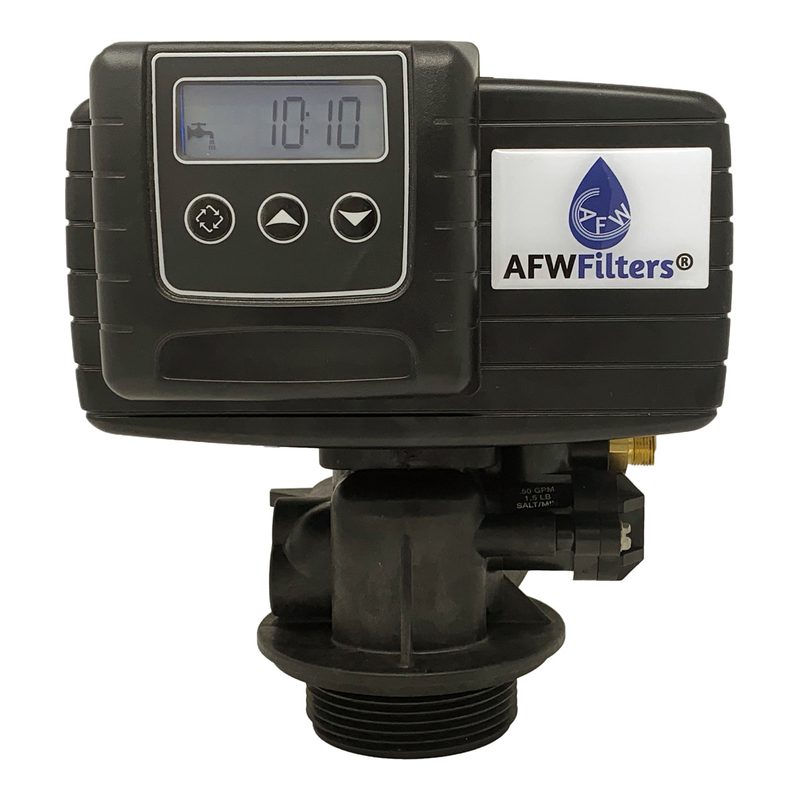
Fleck 5600SXT 48,000-grain softener (AFW Filters build)
A Pentair Fleck 5600SXT metered valve on a 10 x 54 tank with 1.5 ft³ of 8% crosslink resin, sold as a complete system by AFW Filters. The valve is common and widely serviced; the iron limit is not published.
Best for Buyers who want a standard metered Fleck valve and plan to set it up themselves
- Service flow (seller)
- 12gpm
- Peak flow (seller)
- 28gpm
- Valve max backwash
- 7gpm
What we like
- Metered (paddle-wheel) 5600SXT valve, regenerates on water used
- 1.5 ft³ of resin with a 14 x 34 brine tank holding about 250 lb of salt
- 5-year valve and 10-year tank warranty
Watch out for
- Maximum iron is not published
- 8% crosslink resin, where several well-water softeners use 10%
- Seller's 28 gpm peak flow is above the 26 gpm peak on Pentair's valve spec sheet
All specs
- Resin
- 1.5 ft³, 8% crosslink
- Valve rating (Pentair)
- 20 gpm at 15 psi drop, 26 gpm peak
- Operating pressure (valve)
- 20 to 125 psi
- Household (seller)
- Up to 6 people
- Tank
- 10 x 54 in
- Brine tank
- 14 x 34 in, about 250 lb of salt
- Connection
- 1 in yoke with Fleck bypass
- Max iron
- Not published
- Warranty
- 5 years valve, 10 years tank
- Source
- AFW Filters product page; Pentair Fleck 5600SXT spec sheet
Photo: AFW Filters
If your test shows iron, work out the treatment before the softener: the iron filter vs water softener guide turns your numbers into an install order, and the water softeners hub lists every softener we’ve compared by its published limits.
Questions people ask
How long does a Fleck 5600SXT last?
Neither Pentair nor AFW publishes a rated lifespan. Mid Atlantic Water, a Fleck dealer, says the valve runs 15 to 20 years or more with wear parts replaced around year 10 to 15. Those wear parts (seals, spacers, piston) are sold as kits, and resin life depends mostly on the chlorine and iron in your water.
Is the Fleck 5600SXT good for well water with iron?
The valve has no iron rating, and AFW publishes no iron limit for its 48k build. Mid Atlantic lists 2 to 3 ppm for its own 5600SXT build with 10% resin, so above about 2 ppm, plan on an iron filter first or choose a softener whose manual states a higher limit.
Can I program a Fleck 5600SXT myself?
Yes, and you're expected to. Sellers ship it with default settings, and you enter the time, hardness and capacity. For a 1.5 ft³ (48,000-grain) unit, experienced members of the Terry Love forum suggest a capacity of 30,000 grains at 9 lb of salt, or 36,000 at 12 lb, rather than the full 48,000.