 Grain & Gallon
Iron filter vs water softener: which one your well needs, or both
Iron filter vs water softener: match your well test to one or both with Penn State ranges and softener manual iron limits, plus the right install order.
Iron filter vs water softener comes down to what your test shows. A water softener is the right tool when your main problem is hardness and your iron is low and dissolved (the water comes out clear, then stains). An iron filter is the right tool when the water is already orange from the tap, when iron plus manganese reaches 3 mg/L or more, or when you smell rotten eggs. Many wells need both, with the iron filter first and the softener after it.
The deciding numbers are on your water test: hardness, dissolved iron, manganese, hydrogen sulfide and pH, plus your pump’s flow rate. Enter them below. Each note that appears is one published rule, with its source.
Which treatment does my water need?
Enter the numbers from your water test. Each note that appears is a rule from Penn State Extension, NDSU, EPA or a manufacturer's published limit. It covers hardness, iron, manganese, sulfur smell and pH only.
Iron plus manganese
ppm
- Compensated hardness (5 gpg per ppm iron)
- gpg
- Hardness in mg/L
- mg/L
- Under 1 gpg counts as soft (Penn State, NDSU). You do not need a softener for hardness.
- Iron above 0.3 mg/L stains fixtures and laundry. That is EPA's secondary (aesthetic) standard, not a health limit.
- Manganese above 0.05 mg/L causes black or brown staining. That is EPA's secondary (aesthetic) standard.
- A softener can take this iron: dissolved iron under 5 mg/L with hardness of 3 to 20 gpg and pH above 6.7 (Penn State). Set the iron factor from your manual.
- If you don't want to soften, Penn State lists polyphosphate feed for iron under 2 mg/L (it keeps iron from staining but doesn't remove it) and catalytic carbon for iron under 1 mg/L.
- Iron plus manganese of 3 to 10 mg/L: Penn State lists an oxidizing filter (greensand, Katalox-type media or air injection). Put it before any softener.
- Over 10 mg/L combined: oxidation, such as chlorination, followed by filtration (Penn State). NDSU says over 10 ppm may need a dedicated iron removal system.
- Above 5 mg/L dissolved iron, Penn State does not recommend a softener for iron. Some manuals go higher (WaterBoss 900 and Whirlpool WHES40E 10 ppm, Whirlpool WHES44 12).
- Orange water or red particles mean the iron has already oxidized. It clogs softener resin, so filter it out before the softener (Penn State).
- Under about 1 mg/L hydrogen sulfide: activated carbon (Penn State).
- About 1 to 3 mg/L hydrogen sulfide: Penn State lists aeration up to about 2 mg/L and an oxidizing filter up to 2 to 3 mg/L.
- 3 to 6 mg/L falls between Penn State's ranges for oxidizing filters (up to 2 to 3 mg/L) and continuous chlorination (above 6). Ask the filter maker to confirm its sulfur limit for your level; SpringWell WS lists 8 ppm.
- Above 6 mg/L hydrogen sulfide: continuous chlorination followed by filtration (Penn State).
- A smell only in hot water often comes from the water heater's magnesium anode. Penn State suggests replacing it with an aluminum anode before buying treatment.
- Salt-free conditioners need iron, manganese and sulfur removed first. SpringWell FutureSoft lists 0 ppm iron and manganese, Aquasana SimplySoft under 0.3 ppm iron, and Pelican's manual says to remove all iron, manganese and sulfur.
- Aquasana SimplySoft is rated for hardness below 15 gpg. SpringWell FutureSoft lists up to 81 gpg and Pelican NaturSoft up to 75 gpg.
- Aquasana SimplySoft is rated for pH below 8.3.
- Below pH 7: under the minimum for the WaterBoss 900, SpringWell FutureSoft and Pelican NaturSoft. SpringWell's SS softener and WS iron filter list 6.5 to 10. Check the pH range of any product you consider.
- Under 5 gpm is below the backwash minimum of even the smallest iron filter with a published minimum (SoftPro Iron Master 1.0 ft³ needs 5 gpm). Ask the maker for a filter sized to your pump.
- Backwashing filters need a minimum pump flow. SoftPro Iron Master needs 5, 7 and 10 gpm for its 1.0, 1.5 and 2.0 ft³ sizes, so choose a size your pump can backwash.
- The Whirlpool WHES40E manual asks for at least 3 gpm of supply flow.
- This covers nuisance parameters only. For health-related contaminants, test with a certified lab and choose equipment certified to the matching NSF/ANSI standard.
How this works: Each note is one rule from a published source: Penn State Extension (water softening; iron and manganese; hydrogen sulfide), NDSU WQ1031, EPA secondary standards (aesthetic, not health) and manufacturer limits for SpringWell, Aquasana, Pelican, WaterBoss, Whirlpool and SoftPro. Sources disagree on iron: dealers often set 2 ppm, Penn State says under 5 mg/L for softening, and softener manuals rate 10 to 12 ppm. Compensated hardness uses 5 gpg per ppm iron, the factor in the Whirlpool and WaterBoss manuals. mg/L of hardness is gpg times 17.1.
If you don’t have those numbers yet, start with how to read your well water test results. It lists what to ask the lab for before you buy anything.
What an iron filter removes vs a water softener
A softener works by ion exchange. Water passes through a bed of resin beads that hold sodium. Calcium and magnesium (the hardness) stick to the beads and sodium goes into the water. Dissolved iron behaves much like hardness here, so the resin takes it out too, as long as it stays dissolved. Penn State Extension’s iron and manganese guide describes the same exchange for iron and manganese.
An iron filter works by oxidation and filtration. Air, a catalytic media such as greensand or Katalox, or a chemical oxidizer turns dissolved iron into solid particles. The media bed traps them, and a backwash flushes them down the drain. The same process handles manganese and hydrogen sulfide. It does nothing for calcium and magnesium. Our guide to how iron filters work compares the types.
That split explains most of the decision:
- Clear water that stains after standing has dissolved (ferrous) iron. A softener can take a modest amount of it.
- Orange or cloudy water straight from the tap has iron that has already oxidized. Penn State’s water softening guide says this “red-oxidized iron” will clog the resin. It needs a filter.
- Black specks or black staining point to manganese. A rotten-egg smell is hydrogen sulfide. Both are filter jobs at anything beyond low levels.
Three iron thresholds, and why they disagree
Search “how much iron can a water softener remove” and you will find three different answers. All three are real. They come from different people with different goals.
| Source | Iron limit for a softener | What it is |
|---|---|---|
| Dealer blogs (for example Mid Atlantic Water) | About 2 ppm, filter “required” above | A seller’s rule of thumb |
| Penn State Extension | Dissolved iron under 5 mg/L, with hardness 3 to 20 gpg and pH above 6.7 | A university recommendation for homeowners |
| WaterBoss 900 manual | 10 ppm ferrous iron (Wisconsin caps the claim at 5 ppm) | Manufacturer’s rated maximum |
| Whirlpool WHES40E and WHES44 manual | 10 ppm (WHES40E), 12 ppm (WHES44) | Manufacturer’s rated maximum |
A manual’s number is the most iron the unit is rated to take when everything goes right: the iron stays dissolved, you add iron to the hardness setting as the manual says (5 gpg per ppm in both manuals above), and the softener regenerates often enough. Penn State’s number is a recommendation for ordinary households, where those conditions slip. A dealer’s lower number also reflects that dealers sell iron filters, which is not a reason to dismiss it but is a reason to read it as one opinion.
Our reading: under about 2 ppm of dissolved iron, a softener alone is a sound choice if your hardness is in range. Between 2 and 5 mg/L, Penn State still backs a softener, but it has to be sized for the extra load, and the softener size calculator shows how fast iron raises the resin you need. Above 5 mg/L, plan on a filter, even if a manual lists a higher limit.
Iron filter before or after the softener, and when you need both
You need both when the water is hard and the iron is beyond what a softener should carry. Two common cases:
- Hardness above 3 gpg with dissolved iron above 5 mg/L. The softener could technically take some of the iron, but Penn State’s range stops at 5 mg/L.
- Hardness with any orange, oxidized iron, or iron plus manganese of 3 mg/L or more. Penn State lists an oxidizing filter for combined iron and manganese of 3 to 10 mg/L, and oxidation (such as chlorination) followed by filtration above 10.
In an iron filter and water softener combo, the order matters: put the iron filter first, then the softener. Penn State’s softening guide says “filtration prior to softening insures that oxidized iron is not processed in the softener.” With the filter ahead, the softener sees only hardness, so you size it on hardness alone and it uses less salt.
The opposite case needs no filter at all: very hard water with a trace of dissolved iron and no manganese or smell. That is a softener-only well, and the matcher above shows it as one.
Well flow decides which filter can work
Backwashing filters need a minimum flow from the pump to lift and clean the media bed. If your well can’t supply it, the bed never cleans properly and iron starts coming through. Softeners have a supply minimum too, but it is much lower.
- SoftPro Iron Master: at least 5, 7 or 10 gpm of well flow for the 1.0, 1.5 and 2.0 ft³ sizes (SoftPro product page).
- SpringWell WS: backwashes nightly. The SpringWell product page gives no backwash flow, but SpringWell’s installation manual lists 5 gpm for the WS1 and 7 gpm for the WS4.
- Whirlpool WHES40E softener: at least 3 gpm of supply flow, per its manual.
Measure the flow before you shop. Fill a 5 gallon bucket at an outdoor tap near the pressure tank with the pump running, time it, and divide 5 by the minutes. A pump report or well log may also list it. If your flow is under 5 gpm, tell the seller; the smallest filter with a published minimum needs 5. Our picks of the best iron filters for well water list each model’s backwash flow, and our iron filter maintenance guide shows how much water each backwash sends to the drain.
Manganese and sulfur change the answer
Manganese is where softeners are weakest in practice. No softener manual we read gives a sizing factor for it, so our size calculator leaves manganese out of the math and warns you instead. Penn State notes that polyphosphate is “generally ineffective” for manganese and that Birm’s results with it are “highly variable”. If your test shows manganese above EPA’s aesthetic level of 0.05 mg/L, check the manganese limit of any filter you consider: SpringWell WS lists 1 ppm, SoftPro Iron Master 7 ppm.
Hydrogen sulfide is not a softener job at all. Penn State’s hydrogen sulfide guide gives these ranges:
| Hydrogen sulfide | Penn State’s suggested treatment |
|---|---|
| Under 1 mg/L | Activated carbon filtration |
| Up to about 2 mg/L | Aeration (not normally used above this) |
| Up to 2 to 3 mg/L | Oxidizing filter |
| Above 6 mg/L | Continuous chlorination, then filtration |
If the smell is only in hot water, the cause is often the water heater’s magnesium anode rod. Penn State says replacing it with an aluminum rod should clear the odor, which costs far less than a filter. Try that first. Our guide to the sulfur smell in well water walks through the hot and cold tap test that finds the source.
Salt-free conditioners are out for any well with iron, manganese or sulfur unless those are removed first. SpringWell FutureSoft lists 0 ppm iron and manganese and Aquasana SimplySoft under 0.3 ppm iron. Our guide to whether salt-free softeners work covers the rest.
Iron filters to shortlist
These two publish the limits that matter, which is why we list them. Neither is right for every well.
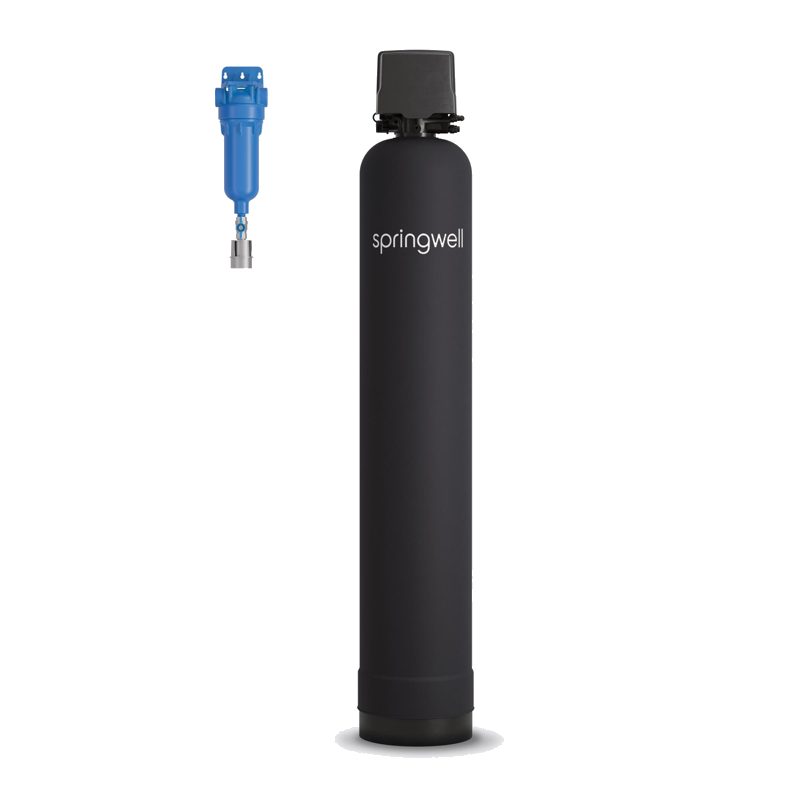
SpringWell WS well water filter
A single-tank air-injection iron filter with published limits for iron, manganese and hydrogen sulfide, and a nightly backwash.
Best for Wells with moderate iron plus a sulfur smell
Photo: SpringWell Water
The SpringWell WS suits a well with moderate iron plus a sulfur smell: its page lists 7 ppm iron and 8 ppm hydrogen sulfide. The weak spot is manganese, limited to 1 ppm. If your manganese is higher, look elsewhere.
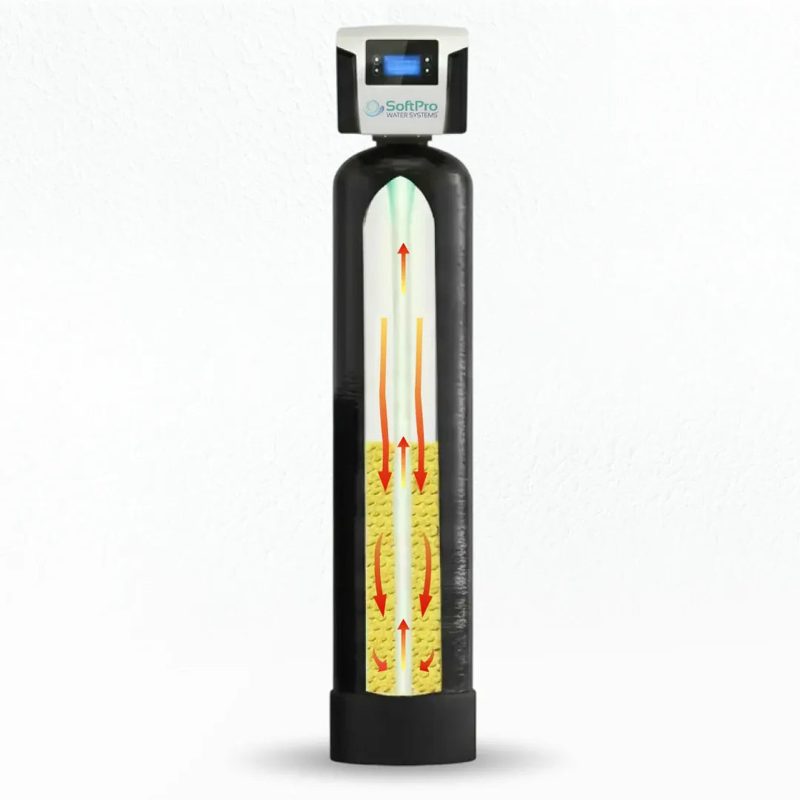
SoftPro Iron Master AIO
An iron filter with Katalox Light media, listed for up to 30 ppm iron and 7 ppm manganese, with a published minimum well flow for each size.
Best for High-iron wells whose pump can meet the backwash minimum
Photo: SoftPro Water Systems
The SoftPro Iron Master is listed for much more iron (30 ppm) and manganese (7 ppm), so it fits high-iron wells. The catch is flow: it needs 5 to 10 gpm to backwash, depending on size, and SoftPro claims sulfur removal without a number. It has no affiliate program, so our link is a plain one.
For how these two brands compare as full well-water setups (filter plus softener), see SpringWell vs SoftPro. If the matcher told you a softener alone will do, go to our picks of the best water softeners for well water, which are chosen on their published iron limits. More guides on iron, sulfur and well tests are in the well water section.
Questions people ask
Does an iron filter soften water?
No. An iron filter oxidizes dissolved iron, manganese and hydrogen sulfide into particles and traps them in its media bed. It leaves calcium and magnesium in the water, so hard water stays hard and you still need a softener for scale.
Should the iron filter go before or after the softener?
Before. Penn State Extension recommends filtration ahead of softening so that oxidized iron never reaches the softener, because red, oxidized iron clogs the resin. The filter takes the iron out and the softener then only has to deal with hardness.
Can a water softener remove iron and manganese?
A softener removes dissolved (clear-water) iron and some manganese by ion exchange. Penn State recommends it only when dissolved iron is under 5 mg/L, hardness is 3 to 20 gpg and pH is above 6.7. It does not handle orange, already oxidized iron, and above those ranges an iron filter is the better tool.