 Grain & Gallon
How much does it cost to run a water softener? Salt, water and a calculator
What it costs to run a water softener per year: salt, regeneration water and dollars from your hardness, household and salt setting, every figure sourced.
A water softener’s running cost is almost all salt, plus the water it flushes down the drain when it regenerates. A household of 4 on 15 gpg water, with 1.5 ft³ of resin at the efficient 6 lb salt setting, uses about 470 lb of salt (12 bags of 40 lb), 52 regenerations and 2,600 gallons of water a year. At $8 a bag that is roughly $94 of salt. Enter your own numbers below, including what you pay for salt, since prices vary by store and by salt type.
Water softener running cost calculator
See how much salt and regeneration water your softener uses in a year, and what that costs at your salt price. It uses the same numbers as our size calculator.
Running cost per year
$
- Compensated hardness
- gpg
- Hardness removed per year
- grains
- Salt setting
- lb per ft³
- Resin capacity at this setting
- grains per ft³
- Salt efficiency at this setting
- grains per lb
- Salt per year
- lb
- 40 lb bags per year
- bags
- Regenerations per year
- Regeneration water per year
- gal
- Higher salt settings get more grains out of each cubic foot but fewer out of each pound of salt: about 3,500 grains per lb at 6 lb per ft³ against about 2,070 at 15 lb (WC&P design table).
- That is a regeneration more often than every 3 days. The resin is small for this household, so check the size calculator.
- Water cost is set to 0, as on a private well. The regeneration water still goes to your drain or septic system; the yearly gallons are shown above.
- With ferrous iron, the WaterBoss manual recommends a resin bed cleaner every 6 months. Cleaner is not counted here.
- Prices this high are typical of potassium chloride (NDSU). This estimate uses sodium chloride figures. NDSU says about 10% more potassium chloride is used per regeneration, so add about 10% to the salt shown.
How this works: Yearly load is compensated hardness (hardness plus iron times your manual's factor) times people times gallons per person times 365. Salt per year is that load divided by the grains each pound of salt removes at your setting, from the WC&P design table: 21,000 grains per ft³ at 6 lb (3,500 per lb), 26,000 at 9 lb (about 2,890), 29,000 at 12 lb (about 2,420) and 31,000 at 15 lb (about 2,070). Regenerations per year are the load divided by the resin's capacity at that setting. Water per regeneration defaults to 50 gallons (Penn State, UNL). Cost is salt (in 40 lb bags, not rounded) times your price, plus regeneration water times your water price. Electricity is left out; the WaterBoss manual lists 0.015 kW-hr on its rating line. Potassium chloride is not modeled separately; NDSU says about 10% more of it is used than sodium chloride.
The salt price field is yours to set. We default it to $8 per 40 lb bag, the middle of the $5 to $10 range that NDSU Extension gives for sodium chloride, but check your own receipt. Water cost is 0 by default because most of our readers are on a private well. On city water, take the combined water and sewer rate per 1,000 gallons from your bill.
Why the salt setting matters more than the brand
Your salt setting (pounds of salt per cubic foot of resin at each regeneration) changes the yearly bill more than anything else you control. The design table published in Water Conditioning & Purification magazine shows why: each extra pound of salt removes less hardness than the one before it.
Here is the same household (4 people, 15 gpg, 1.5 ft³ of resin, $8 a bag, well water) at each setting in that table:
| Salt setting | Grains removed per lb | Salt per year | 40 lb bags | Regenerations | Water per year | Salt cost |
|---|---|---|---|---|---|---|
| 6 lb per ft³ | about 3,500 | 469 lb | 12 | 52 | 2,610 gal | $94 |
| 9 lb per ft³ | about 2,890 | 569 lb | 15 | 42 | 2,110 gal | $114 |
| 12 lb per ft³ | about 2,420 | 680 lb | 17 | 38 | 1,890 gal | $136 |
| 15 lb per ft³ | about 2,070 | 795 lb | 20 | 35 | 1,770 gal | $159 |
The efficient setting uses about 40% less salt than the maximum. It pays for that with more regenerations, so about 840 more gallons a year go to the drain. On a well that water costs you only pump electricity, which is why we default to 6 lb. On metered city water, enter your rate and see where the balance falls.
Modern demand softeners are rated at settings below the WC&P table. The NSF/ANSI 44 standard for residential softeners has an “efficiency rated” claim that, per the WaterBoss and Whirlpool manuals, means at least 3,350 grains of hardness removed per pound of salt. The manuals then list their own ratings at the lowest salt dose:
- WaterBoss 900: 5,510 grains per lb at 1 lb (WaterBoss manual)
- Whirlpool WHES40E: 4,958 grains per lb at 2.4 lb (Whirlpool manual)
Those are lab ratings at a very small dose, and the manuals themselves say efficiency in the field is typically less. The calculator uses the WC&P figures, which are more conservative. If you own one of these units and run it at its lowest setting, your real salt use may come in below the estimate.
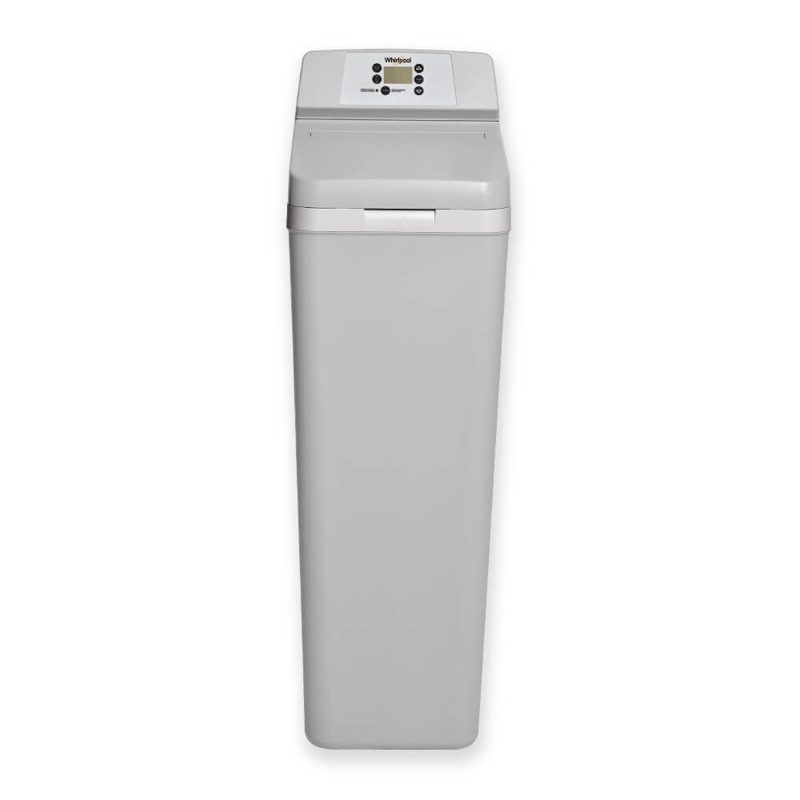
Whirlpool WHES40E
A 40,000-grain cabinet softener whose manual publishes every limit a well owner needs to check: clear-water iron, maximum hardness, minimum supply flow, salt efficiency and regeneration water.
Best for Most private wells with moderate hardness and clear-water iron up to 10 ppm
Photo: Whirlpool Water Solutions
The Whirlpool’s manual publishes capacity at three salt doses, from 11,900 grains at 2.4 lb through 31,600 at 9.0 lb to 40,000 at 15.5 lb, so you can see what a lower setting costs you in capacity before you choose it. It uses 37.1 gallons of water per regeneration at the maximum dose, more than the WaterBoss.
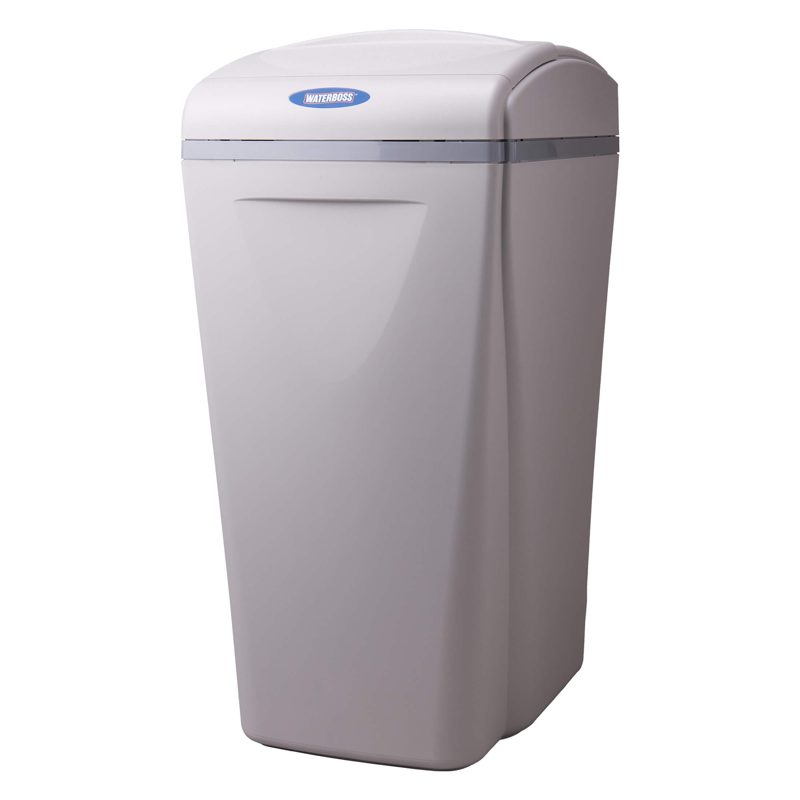
WaterBoss 900
A compact 1 ft³ cabinet softener with fine-mesh resin and a built-in sediment filter, rated in its manual for 10 ppm ferrous iron and very frugal at its lowest salt setting.
Best for Small utility rooms and households that want low salt and water use
Photo: WaterBoss
The WaterBoss 900 has the highest efficiency rating we found and the least regeneration water, 17.2 to 32 gallons. It holds only 1 ft³ of resin and needs a pH of at least 7, so it suits smaller households on non-acidic water.
How much water each regeneration sends to the drain
Each regeneration backwashes the resin, draws brine through it and rinses it. Penn State Extension puts that at about 50 gallons per regeneration, and Nebraska Extension says about 50 gallons too, roughly one load of laundry in an older washer. That is the calculator’s default.
Newer demand units use less. The Whirlpool WHES40E uses 37.1 gallons at its maximum salt dose. The WaterBoss 900 uses 17.2 gallons at its 1 lb dose and 32 gallons at 15 lb. If you know your model, enter its figure in the water field.
On a well, this water still goes somewhere: down the drain and, in many homes, into the septic system. The calculator shows the yearly gallons even when the cost is 0.
Electricity is close to nothing
The control valve draws power for its clock or meter and to turn the valve during regeneration. The WaterBoss manual’s electrical rating line lists 0.015 kW-hr. We haven’t checked the Whirlpool manual for the same line, so we don’t quote a figure for it. Next to salt, the WaterBoss figure is negligible, so the calculator leaves electricity out. If you see a yearly electricity cost of tens of dollars quoted for a softener, ask where the number came from.
Non-electric water softeners exist too. Kinetico, a dealer-sold brand, says its non-electric models use a mechanical water meter and no electricity to regenerate. With electricity already this small, electric vs non-electric barely changes the running cost: salt and regeneration water still decide it.
Sodium chloride (NaCl) or potassium chloride (KCl)
Potassium chloride replaces the sodium in the softening process with potassium. It costs more to run, for two reasons that NDSU spells out: up to $25 per 40 lb bag against $5 to $10 for sodium chloride, and about 10% more of it used per regeneration because it holds on to the resin more strongly. Nebraska Extension adds that it can be harder to find.
The calculator uses sodium chloride figures. For potassium chloride, enter your bag price and add about 10% to the salt amount it shows.
NDSU and Nebraska Extension both mention potassium chloride for homes that need to restrict the sodium a softener adds. Penn State gives that figure as 7.5 milligrams per quart for each gpg of hardness removed, so water at 15 gpg picks up about 110 milligrams per quart. Nebraska Extension gives about 8 mg/L per gpg. Whether that matters for you is a question for your doctor, not for us.
Four ways to cut a water softener’s running cost
- Use a lower salt setting and more resin. In the table above, going from 15 lb to 6 lb per ft³ saves about 325 lb of salt a year for the same household. If you haven’t bought yet, size for the efficient setting with our water softener size calculator.
- Choose metered (demand) regeneration. A timer-only softener regenerates on a schedule whether you used the capacity or not. A metered valve counts gallons and regenerates when the resin is actually used up, so a week away or a quiet month costs no salt.
- Set the hardness correctly. The valve works out its capacity from the hardness number you enter. Enter your measured hardness plus your manual’s iron allowance, as our water softener hardness setting guide explains. A setting higher than your water needs makes it regenerate early and waste salt, and a lower one lets hard water through.
- Treat iron at the right point. Each ppm of clear-water iron counts as 3 to 5 gpg of extra hardness, depending on the manual, so at 15 gpg 1 ppm of iron adds up to a third to your salt. With enough iron, an iron filter ahead of the softener is the cheaper setup over time. Our guide to iron filters vs water softeners shows where that line falls.
If you want to drop salt entirely, know what you’d be buying: salt-free systems reduce scale but don’t soften, and most need water with no iron. Our guide to whether salt-free water softeners work covers what they do and don’t do, and our salt-free vs salt water softener comparison sets the running costs side by side.
Next step
If your yearly salt looks high for your household, check the resin size first. The calculator warns when a softener regenerates more often than every 3 days, which usually means it’s too small. For models whose manuals publish salt efficiency, iron limits and regeneration water, see our best water softeners for well water. More guides are in sizing and running costs.
Questions people ask
How many bags of salt does a water softener use a year?
A household of 4 on 15 gpg water uses about 12 bags of 40 lb a year at the efficient 6 lb per ft³ setting, and about 20 bags at the maximum 15 lb setting. Harder water, iron or more people raise it in proportion.
Does a water softener use a lot of electricity?
No. The WaterBoss manual lists 0.015 kW-hr on its electrical rating line, which is a rounding error next to salt. Salt is where the money goes.
Is potassium chloride more expensive to run than salt?
Yes, on two counts. NDSU gives up to $25 per 40 lb bag for potassium chloride against $5 to $10 for sodium chloride, and says about 10% more potassium chloride is used per regeneration.