 Grain & Gallon
Best water softeners for well water, matched to your iron and hardness
The best water softeners for well water, ranked by the iron, hardness, pH and flow limits in their manuals, plus the limits each maker leaves out.
Our picks at a glance
- Best overall for most wells
Most private wells with moderate hardness and clear-water iron up to 10 ppm
- Resin
- 1.14 ft³
- Rated flow
- 8.5 gpm
- Max clear-water iron
- 10 ppm
See where to buy (opens Whirlpool site)Opens whirlpoolwatersolutions.com - Best for larger homes
Larger homes that need 15 to 20 gpm of service flow
- Best upflow metered system
SoftPro Elite Smart HE (well-water version)
Well owners who want an upflow metered system with sturdier resin
- Best for high flow
SpringWell SS salt-based softener
Homes with many bathrooms that need high flow
- Best budget pick
Small utility rooms and households that want low salt and water use
- Peak flow
- 7.5 gpm
- Max compensated hardness
- 90 gpg
- Best fine-mesh resin option
Aquasure Harmony 48,000 fine-mesh (AS-HS48FM)
Well owners who want fine-mesh resin for clear-water iron
- Capacity
- 48,000 grains
For most private wells with clear-water iron under 5 ppm, the Whirlpool WHES40E is the best water softener for well water: its manual publishes every limit you need to check against your test, including 10 ppm of clear-water iron, 125 gpg of hardness and a 3 gpm minimum supply flow. If your dissolved iron is above 5 ppm, or your water comes out of the tap orange, put an iron filter in front of any softener on this list.
The other five picks cover larger homes, high flow, tight budgets and small utility rooms. Each one comes with the maker’s own limits and the ones it leaves out.
How we chose
We compared softeners on the numbers a well owner has to match, taken from owner’s manuals where they exist and from the maker’s product page where they don’t. We haven’t installed these units. This is research from manufacturer documents and extension-service guidance, and the about page explains the method.
The order of our criteria follows from what goes wrong on wells:
- Fit for well water. Maximum clear-water iron, maximum hardness, pH range and flow, checked against the ranges Penn State Extension gives for softening iron.
- How much the maker publishes. A softener whose manual lists its iron limit and capacity at each salt dose ranks above one whose page doesn’t, because you can check it against your own report. Where a limit is missing, we write “not published”.
- Running cost. Capacity at an efficient salt setting and the water each regeneration uses.
- Where to buy. A clear online buy path, preferably with a real manual you can download before you order.
We don’t give star ratings. Without measurements of our own, a 4.6 against a 4.4 would be invented precision.
What kind of water softener your well needs
If you’re choosing a water softener for well water with iron, your iron number decides whether a softener is the right machine. Use the dissolved (ferrous) iron from your lab report; ppm and mg/L are the same thing.
| Dissolved iron | What to do | Source |
|---|---|---|
| 0 to 2 ppm | Any softener below with a published iron limit should cope; ask the others for theirs. Add 5 gpg to the hardness setting per 1 ppm of iron. | Whirlpool and WaterBoss manuals |
| 2 to 5 ppm | A softener still suits if hardness is 3 to 20 gpg and pH is above 6.7. Pick one rated well above your number. | Penn State |
| 5 to 10 ppm | Inside some manual limits but above Penn State’s softening range. An oxidizing iron filter first is the safer plan. | Penn State (iron plus manganese of 3 to 10 mg/L) |
| Over 10 ppm, or red iron | Iron filter first. Softener manuals say they won’t remove ferric (red water) iron. | Penn State; NDSU WQ1031 |
The 5 to 10 ppm row is where sources disagree. The Whirlpool and WaterBoss manuals rate their softeners for 10 ppm, yet both note a 5 ppm Wisconsin limit on clear-water iron. Some dealers go further and want an iron filter above 2 ppm. Our reading: the manual figure rests on the WQA test data the manuals cite, while Penn State’s lower figure is a recommendation for ordinary homes, where conditions are rarely ideal.
If you’re not sure which lines on your report matter, start with how to read well water test results. Our guide to iron filters vs water softeners has a matcher that turns hardness, iron, manganese, pH and smell into a system type.
Our picks for well water
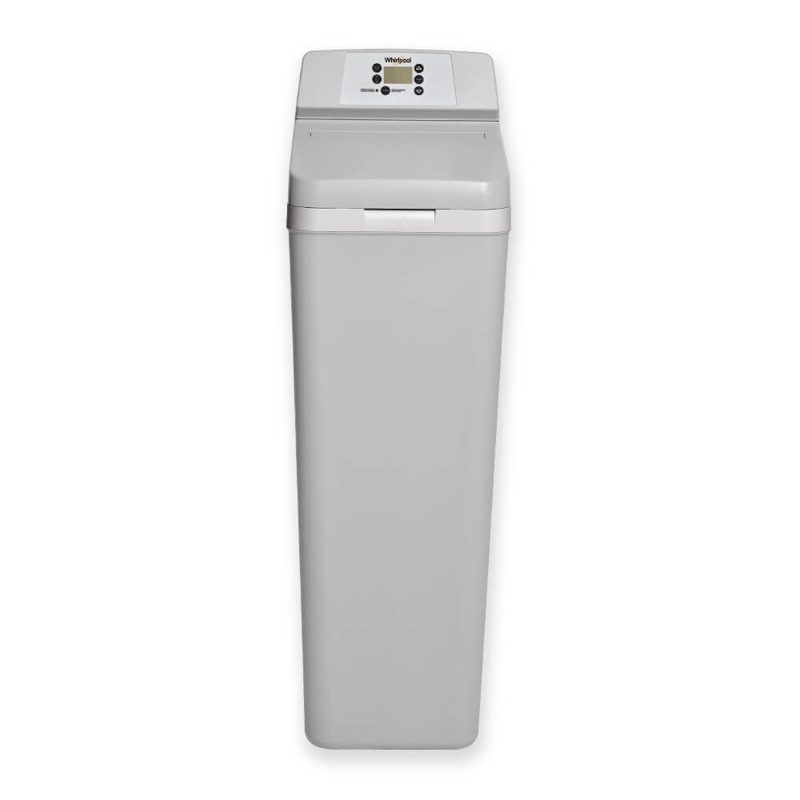
Whirlpool WHES40E
A 40,000-grain cabinet softener whose manual publishes every limit a well owner needs to check: clear-water iron, maximum hardness, minimum supply flow, salt efficiency and regeneration water.
Best for Most private wells with moderate hardness and clear-water iron up to 10 ppm
- Resin
- 1.14ft³
- Rated flow
- 8.5gpm
- Max clear-water iron
- 10ppm
- Max hardness
- 125gpg
What we like
- Manual lists 10 ppm clear-water iron and 125 gpg maximum hardness
- Full salt-dose table: 11,900 grains at 2.4 lb up to 40,000 grains at 15.5 lb
- Rated efficiency of 4,958 grains per lb at its lowest salt setting
Watch out for
- 8.5 gpm rated flow is low for large homes with several showers running
- Needs at least 3 gpm of supply flow, which some weak wells can't give
- Cabinet-style unit, so you can't move to a larger resin tank later
All specs
- Capacity
- 11,900 grains at 2.4 lb, 31,600 at 9.0 lb, 40,000 at 15.5 lb
- Min supply flow
- 3 gpm
- Water per regeneration
- 37.1 gal at maximum salt
- Iron rule in manual
- Add 5 grains per 1 ppm ferrous iron
- Source
- Whirlpool WHES40/WHES44 owner's manual
Photo: Whirlpool Water Solutions
The WHES40E earns the top spot because its owner’s manual answers every question a well owner should ask before buying. It lists 10 ppm of clear-water iron, 125 gpg of hardness, 20 to 125 psi, and a minimum supply flow of 3 gpm. It also gives capacity at three salt doses, from 11,900 grains at 2.4 lb to 40,000 at 15.5 lb, and 37.1 gallons of water per regeneration at the maximum dose.
It suits a small to mid-size household on moderately hard well water with dissolved iron under 5 ppm. The manual doesn’t give a pH range, so check your pH against Penn State’s 6.7 floor yourself.
The downside is flow. It’s rated for 8.5 gpm at an 11 psi drop, which is tight for a large home running two showers and a washer at once. The manual’s 16.2 gpm intermittent figure is not a service rating, and it says so. It’s also a cabinet unit, so you can’t swap in a bigger resin tank later.
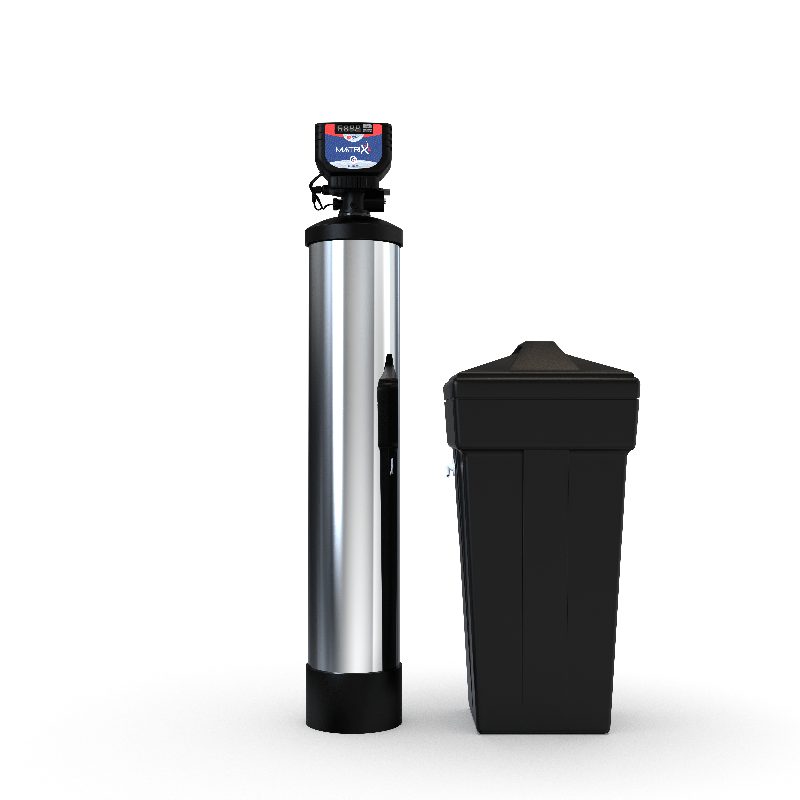
US Water Systems Matrixx
A metered softener sold in 1.0, 1.5 and 2.0 ft³ sizes, and the only seller page we found that lists capacity at maximum salt and at a high-efficiency setting side by side.
Best for Larger homes that need 15 to 20 gpm of service flow
What we like
- Service flow of 10, 15 or 20 gpm by size
- Publishes maximum and high-efficiency capacity for every size
- 10% crosslink resin
Watch out for
- Maximum iron is not published on the product page
- Maximum hardness and pH range are not published either
- High-efficiency capacity is less than half the headline number, so size from the lower figure
All specs
- Sizes
- MXX-100 (1.0 ft³), MXX-150 (1.5 ft³), MXX-200 (2.0 ft³)
- Capacity, max / high efficiency
- 35,000 / 15,000; 53,000 / 22,500; 70,000 / 30,000 grains
- Service flow
- 10, 15 or 20 gpm by size
- Peak flow
- 12, 17 or 22 gpm by size
- Resin
- 10% crosslink
- Max iron
- Not published
- Source
- US Water Systems product page
Photo: US Water Systems
The Matrixx comes in 1.0, 1.5 and 2.0 ft³ sizes with service flows of 10, 15 and 20 gpm, the range a big house on a strong well needs. Its product page is the most complete salt-dose table we found from a seller: at the high-efficiency setting (3 lb per ft³) the three sizes give 15,000, 22,500 and 30,000 grains, and at the 6 lb per ft³ setting they give 24,000, 36,000 and 48,000.
The catch is iron. US Water Systems publishes no maximum iron, no maximum hardness and no pH range for the Matrixx. Its own FAQ advises against relying on a softener for iron and suggests an iron filter ahead of it. Treat this as a softener for hardness on a well where iron is low or already handled.
The page also lists two different maximum capacities (35,000 in one table and 32,000 at 15 lb in another for the 1.0 ft³ size). Size from the efficient figures and the difference won’t matter.
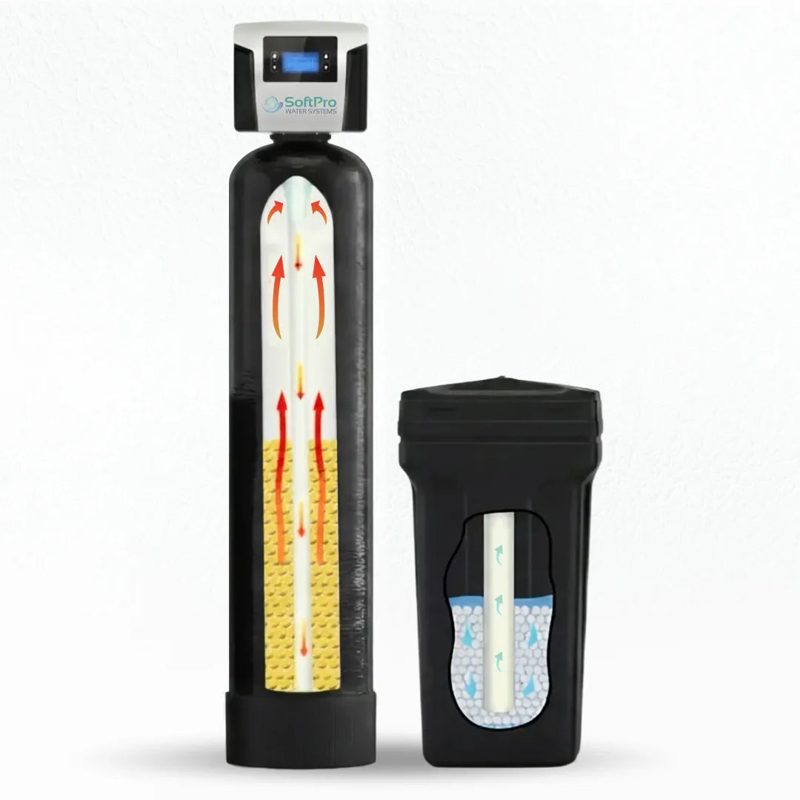
SoftPro Elite Smart HE (well-water version)
An upflow softener with metered demand regeneration and 10% crosslink resin, sold in a well-water version and chosen by flow band rather than a fixed grain rating.
Best for Well owners who want an upflow metered system with sturdier resin
What we like
- Upflow valve with metered demand regeneration
- 10% crosslink resin
- 32k, 40k, 48k and 64k grain options
Watch out for
- Iron limit (3 ppm) appears only on SoftPro's own comparison page, not the product page
- Maximum hardness is not stated on the product page
- No affiliate program, so our link to it is a plain link
All specs
- Sizes
- 32,000, 40,000, 48,000 and 64,000 grains
- Resin
- 10% crosslink
- Regeneration
- Upflow, metered demand
- Flow
- Sold by band: 6 to 7, 8 to 10, 11+ gpm
- Max iron
- Not on the product page (3 ppm per SoftPro's comparison page)
- Max hardness
- Not published
- Source
- SoftPro product page
Photo: SoftPro Water Systems
The Elite uses an upflow valve with metered regeneration and 10% crosslink resin, which sellers pitch as longer-lasting than the standard 8%. SoftPro’s product page sells it in 32,000, 40,000, 48,000 and 64,000-grain sizes and asks for your well pump’s flow band (6 to 7, 8 to 10, or 11+ gpm) rather than quoting one flow rating.
The iron limit appears only on SoftPro’s own comparison page, which gives 3 ppm of ferrous iron. That’s a seller claim and the lowest published iron figure here. The product page’s own size picker describes the softener-only option as for “hardness only (no iron or odor issues)” and steers iron wells toward a bundle with an iron filter. Maximum hardness and efficient-salt capacity aren’t published.
SoftPro has no affiliate program, so the button goes to SoftPro with a plain link and we earn nothing from it. It’s on the list because the upflow design and resin grade suit well owners who want a metered system. Our SpringWell vs SoftPro comparison goes through both brands’ limits side by side.
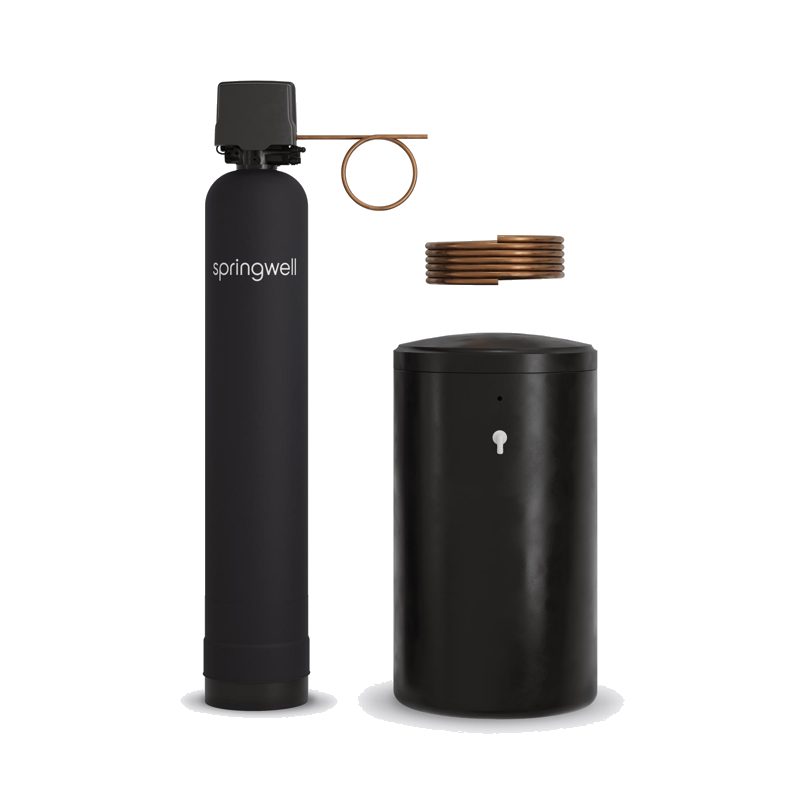
SpringWell SS salt-based softener
A salt-based softener sold by bathroom count, with flow ratings up to 20 gpm and a published pH range of 6.5 to 10.
Best for Homes with many bathrooms that need high flow
What we like
- Flow ratings of 11, 13 and 20 gpm
- pH range of 6.5 to 10 covers slightly acidic wells
- Sold direct with a 32k, 48k and 80k size ladder
Watch out for
- Maximum iron is not published on the product page
- Maximum hardness is not published either
- Pair it with an iron filter if your well has iron
All specs
- Sizes
- SS1 32k (9x48 tank), SS4 48k (10x54), SS+ 80k (13x54)
- Flow
- 11, 13 or 20 gpm by size
- Household
- 1 to 3, 4 to 6, or 7+ bathrooms
- pH range
- 6.5 to 10
- Pressure
- 25 to 80 psi
- Max iron
- Not published
- Source
- SpringWell product page
Photo: SpringWell Water
SpringWell sizes the SS by bathroom count: 11 gpm for 1 to 3 bathrooms, 13 gpm for 4 to 6 and 20 gpm for 7 or more, according to its spec table. It also lists a pH range of 6.5 to 10, which covers slightly acidic wells that the WaterBoss rules out.
The spec table doesn’t list a maximum iron or maximum hardness for any size. SpringWell’s warranty terms, on the same page, void coverage when a system is installed on water beyond its recommended specification. That makes the missing iron figure more than a detail, so get it in writing before you buy for a well with iron. SpringWell sells a WS iron filter to go in front of it, rated for 7 ppm of iron. Operating pressure is 25 to 80 psi, narrower than the 20 to 125 psi of the Whirlpool cabinet unit.
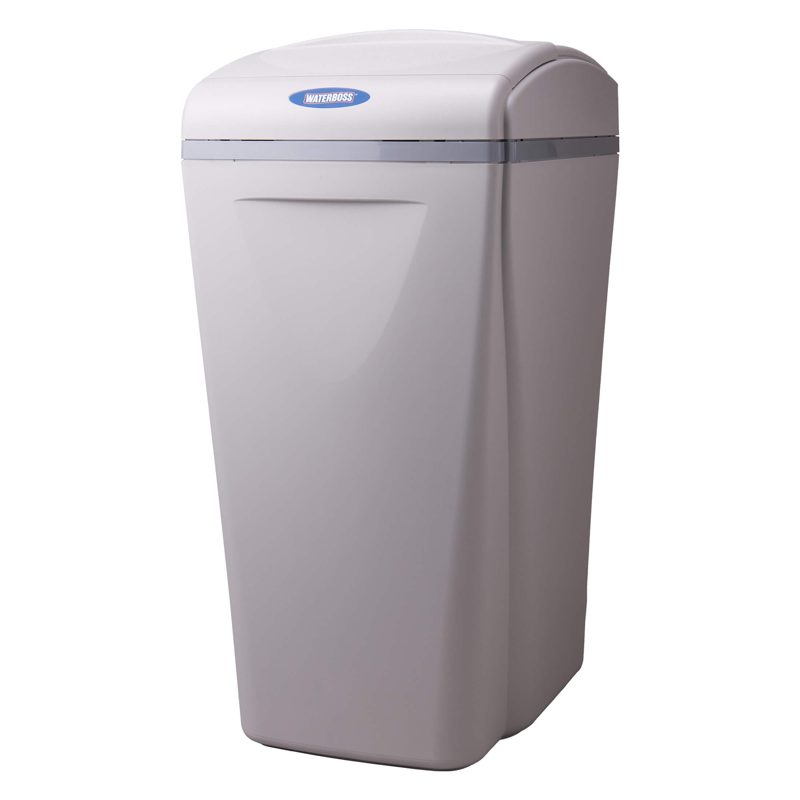
WaterBoss 900
A compact 1 ft³ cabinet softener with fine-mesh resin and a built-in sediment filter, rated in its manual for 10 ppm ferrous iron and very frugal at its lowest salt setting.
Best for Small utility rooms and households that want low salt and water use
- Peak flow
- 7.5gpm
- Max compensated hardness
- 90gpg
- Min pH
- 7
What we like
- Manual lists 10 ppm ferrous iron and 90 gpg compensated hardness
- 5,510 grains per lb at a 1 lb salt dose, the most efficient rating we found
- 17.2 to 32 gallons of regeneration water, less than most units
Watch out for
- Minimum pH of 7 rules out acidic wells
- Wisconsin caps its iron claim at 5 ppm, per the manual
- 7.5 gpm peak flow suits smaller homes
All specs
- Capacity
- 5,510 grains at 1 lb, 28,775 at 8 lb, 36,490 at 15 lb
- Resin
- 1 ft³ super fine mesh, plus self-cleaning filter media
- Max ferrous iron
- 10 ppm (5 ppm claim in Wisconsin)
- Water per regeneration
- 17.2 gal at 1 lb, 23.5 at 8 lb, 32 at 15 lb
- Source
- WaterBoss 700/900/950 owner's manual
Photo: WaterBoss
The WaterBoss 900 cost the least of our picks when we checked, and it gives up less on paperwork than you’d expect for that. It packs 1 ft³ of fine-mesh resin and a built-in sediment filter into a small cabinet. Its manual rates it under NSF/ANSI 44, the standard for residential softeners, at 5,510 grains per pound at a 1 lb dose, the most efficient figure on this list, and it uses 17.2 to 32 gallons per regeneration. The same manual gives capacity at three salt doses, from 5,510 grains at 1 lb to 36,490 at 15 lb.
It’s rated for 10 ppm of ferrous iron and 90 gpg of compensated hardness, but it needs a pH of at least 7, so check your pH before anything else. Peak flow is 7.5 gpm, so it fits a smaller household better than a busy family.
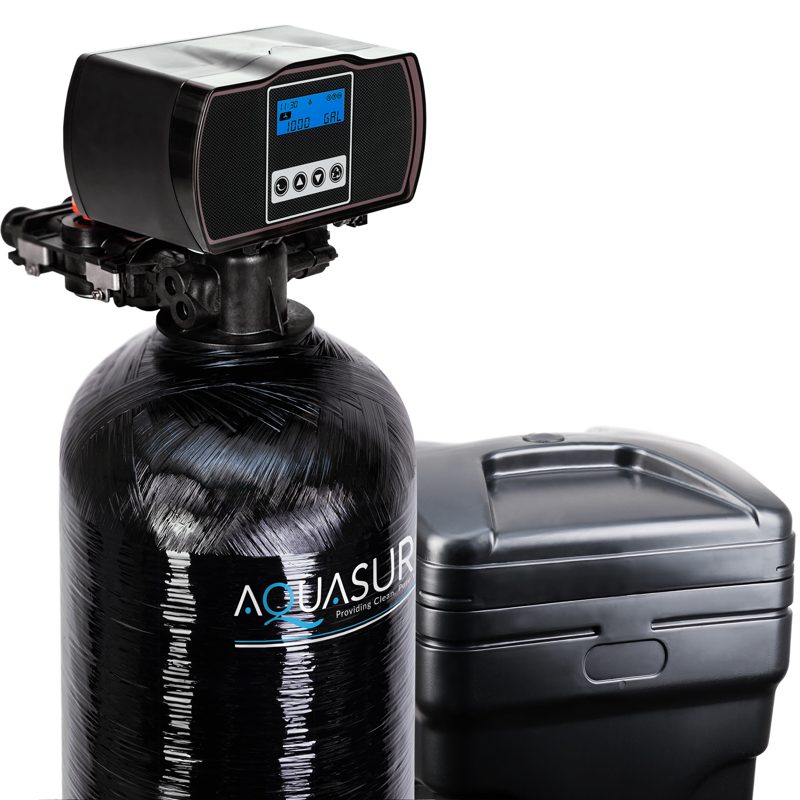
Aquasure Harmony 48,000 fine-mesh (AS-HS48FM)
A 48,000-grain softener with fine-mesh resin that Aquasure sells for removing up to 10 ppm of iron.
Best for Well owners who want fine-mesh resin for clear-water iron
- Capacity
- 48,000grains
What we like
- Fine-mesh resin sold for up to 10 ppm iron
- Sized for 3 to 4 bathrooms and up to 5 people
- 1 inch or 3/4 inch NPT connections
Watch out for
- The 10 ppm iron figure is a seller claim, with no manual figure we could check
- Flow rate, maximum hardness and regeneration water aren't on the maker page for this model
- No capacity figures at efficient salt settings
All specs
- Resin
- Fine mesh
- Max iron
- Up to 10 ppm (seller claim)
- Household
- 3 to 4 bathrooms, up to 5 people
- Connections
- 1 in or 3/4 in NPT
- Flow and max hardness
- Not published on the maker page
- Source
- Aquasure product page
Photo: Aquasure
Aquasure’s page sells this 48,000-grain model for removing up to 10 ppm of iron in a home with 3 to 4 bathrooms.
It ranks last because that’s nearly all Aquasure publishes about the fine-mesh model. We found no flow rating, no maximum hardness, no regeneration water and no capacity at efficient salt settings on the maker page. Figures you’ll see elsewhere belong to the standard-resin model and don’t carry over. There’s no manual figure behind the 10 ppm claim that we could check.
Manufacturer limits side by side
This is what each maker publishes, and what it doesn’t. Capacity is shown at the lowest and highest salt dose the source lists.
| Softener | Max iron | Max hardness | pH | Flow | Capacity, low / max salt |
|---|---|---|---|---|---|
| Whirlpool WHES40E | 10 ppm | 125 gpg | Not published | 8.5 gpm | 11,900 at 2.4 lb / 40,000 at 15.5 lb |
| US Water Matrixx (1.0 ft³) | Not published | Not published | Not published | 10 gpm | 15,000 at 3 lb / 32,000 at 15 lb |
| SoftPro Elite | 3 ppm (comparison page only) | Not published | Not published | By well flow band | Not published / 32,000 to 64,000 |
| SpringWell SS | Not published | Not published | 6.5 to 10 | 11, 13 or 20 gpm | Not published / 32,000 to 80,000 |
| WaterBoss 900 | 10 ppm | 90 gpg | 7 minimum | 7.5 gpm peak | 5,510 at 1 lb / 36,490 at 15 lb |
| Aquasure Harmony FM48 | 10 ppm (seller claim) | Not published | Not published | Not published | Not published / 48,000 |
The two big-box cabinet units publish the most, because their manuals follow NSF/ANSI 44 and state capacity at each salt dose. The direct sellers publish flow and sizes, but three of the four leave out an iron limit on the product page.
Which one should you get?
Start with your iron, then your household.
| Your situation | Get |
|---|---|
| Small household or tighter budget, pH 7 or above, iron under 5 ppm | WaterBoss 900 |
| Mid-size household, iron under 5 ppm, want the most published limits | Whirlpool WHES40E |
| Large home, iron low or already filtered | US Water Matrixx (1.5 or 2.0 ft³) |
| 7 or more bathrooms, or a pH as low as 6.5 | SpringWell SS+ with an iron filter ahead of it |
| Want upflow metered regeneration, iron under 3 ppm | SoftPro Elite |
| Iron over 5 ppm, red iron or a sulfur smell | An iron filter first, then any of the above |
Size by resin volume, not the nameplate grain number. The nameplate is the capacity at maximum salt, and at an efficient setting you get far less: 31,600 grains instead of 40,000 on the Whirlpool at 9.0 lb. Our guide to water softener grain capacity explains how the rating changes with salt. Our water softener size calculator takes your hardness, iron and household and gives the resin volume at the salt setting you choose. Then check what that setting costs a year with the running cost calculator.
What we left out and why
- GE GXSH40V. It was our budget pick until GE’s own product page listed it as no longer manufactured, and the larger GXSH45V is marked the same way. We only recommend softeners you can still buy new.
- WaterBoss 950. Its manual rates it for 0 ppm of iron. It’s built for city water with chlorine, so it’s the wrong unit for a well.
- Culligan, Kinetico, EcoWater and RainSoft. These are sold through local dealers, not online. We can’t link a product or a manual you can check before a salesperson visits.
- Fleck 5600SXT dealer builds. They’re popular with DIY installers, but the builds we looked at publish no iron limit. Our Fleck 5600SXT review covers the valve and the AFW build.
- Salt-free conditioners. They don’t soften, and the ones we checked need iron at or near zero. See whether salt-free softeners work before considering one on a well, or our best salt-free water softeners if you’re on city water.
For more on softeners, see our water softeners hub.
Questions people ask
Do you need a water softener for well water?
Only if your test shows hardness worth removing. Penn State Extension calls water under 1 gpg soft, and many wells are fine without one. If your problem is iron or a sulfur smell rather than scale, an iron filter may be the better first purchase.
Can a water softener remove iron?
It can remove dissolved (clear-water) iron within its rated limit, which is 10 ppm in the Whirlpool and WaterBoss manuals. The same manuals say a softener will not remove ferric (red water) or bacterial iron, and Penn State recommends a softener for iron only below 5 mg/L.
Does the iron filter go before or after the softener?
Before. The filter takes out iron and sediment that would otherwise foul the softener resin, and the Matrixx seller page gives the same advice for wells with iron.
What size softener do I need for well water?
Add 5 gpg to your hardness for every 1 ppm of clear-water iron, as the Whirlpool and WaterBoss manuals say, then size from that number. Our size calculator does the math at the salt setting you choose.