 Grain & Gallon
Do salt-free water softeners work? What the research and the spec sheets say
Do salt-free water softeners work? They cut scale but leave hardness in. What independent studies measured, each maker's limits, and when salt is better.
Salt-free water softeners work for one job: reducing the scale that hard water leaves in water heaters and pipes. They do not soften water. The calcium and magnesium stay in, so your water tests just as hard afterwards and bar soap still leaves curd. Still, the best independent lab study found that the leading type, template-assisted crystallization (TAC), cut water heater scale by more than 88%. They also need clean water to start with: most spec sheets call for zero or near-zero iron and manganese, which rules out most untreated wells.
So the honest answer to “do salt free water softeners work” is: yes for scale on city water within the maker’s limits, no if you want soft water, and usually no on a well with iron. The rest of this page shows where each of those answers comes from.
What “salt-free” actually means
Softeners and the things sold as salt-free alternatives work in completely different ways, and only the first removes hardness.
- Ion-exchange softeners (the salt kind). Resin beads swap calcium and magnesium for sodium, then get flushed with brine. This is the only home option on this list that removes hardness, and it’s what the NSF/ANSI 44 standard for residential cation-exchange softeners covers.
- TAC (template-assisted crystallization) media. Water flows through a tank of polymer beads with nucleation sites on their surface. Dissolved hardness forms microscopic calcium carbonate crystals that break off and float through the plumbing instead of building up on hot surfaces. SpringWell lists FutureSoft as TAC. Pentair’s NaturSoft manual describes a “catalytic surface” on its media without using the TAC name, and Aquasana calls its media “Scale Control Media” and describes it as changing the charge of the hardness ions, without naming TAC.
- Electronic and magnetic descalers. A coil wrapped around the pipe carries an electrical signal. The iSpring ED2000 is a common example. There’s no tank and no media.
A fourth group adds a chemical instead: cartridges that slowly release a chelating agent such as citrate, or a phosphonate. The WateReuse study describes these as well established in industry and possibly effective, but left them out of its testing. The cartridges run out and must be replaced, since the chemical is used up.
What the research says about salt-free softeners
The study everyone cites is WateReuse Research Foundation project 08-06, Evaluation of Alternatives to Domestic Ion Exchange Water Softeners, released in 2014. It was led by Peter Fox at Arizona State University (not the University of Arizona) and paid for by water agencies and cities, including Phoenix and Scottsdale. Its goal was finding alternatives to salt softeners, because softener brine raises the salt load in recycled wastewater.
The setup followed the German DVGW W512 test for scale-prevention devices. Water ran through each device into a small electrically heated 10-liter tank for about 3 weeks, and then the researchers dissolved and weighed the calcium scale on the heating element and tank walls. Here are the report’s scale totals, in grams of calcium carbonate:
| Water tested | Hardness | No treatment | TAC | Electromagnetic | Electrically induced precipitation |
|---|---|---|---|---|---|
| Tempe tap, 80°C | 180 mg/L (10.5 gpg) | 13.36 g | 0.48 g | 7.56 g | 6.72 g |
| Tempe tap, 60°C | 180 mg/L (10.5 gpg) | 9.97 g | 0.33 g | 5.28 g | 5.56 g |
| Colorado River (CAP) | 150 to 250 mg/L (9 to 15 gpg) | 20 g | 0.65 g | 10.23 g | 9.84 g |
| Scottsdale groundwater | 450 to 500 mg/L (26 to 29 gpg) | 29.75 g | 3.2 g | 16.7 g | 15.4 g |
That works out to about 89% to 97% less scale for TAC and roughly 43% to 51% for the two electrical devices. The report’s own summary says TAC reduced scale by “greater than 88 percent” and both electrical types by about 50%, and it notes the electrical devices left a soft scale that brushed off easily. The TAC unit tested was a Next ScaleStop, the media US Water Systems lists for its GreenWave system.
What the study did not show matters just as much:
- Spots and film on fixtures were not tested. The authors say no credible method existed for residue left where water evaporates, like glass shower doors and faucets. Any claim that a salt-free unit ends water spots rests on marketing and anecdote, not this study.
- It was short. About 20 days, in lab heaters, so it says nothing about how long media lasts or about scale building up over years.
- The hardest water tested was about 29 gpg. SpringWell rates FutureSoft to 81 gpg and Pelican rates NaturSoft to 75 gpg. We found no independent data at those levels.
- Iron and manganese weren’t part of it. All three waters were treated municipal or treated groundwater.
- Hardness stayed in the water. The 2013 webinar slides note that free calcium drops after physical water treatment devices but returns to its starting level in 2 to 3 days. None of the devices removes calcium from the water.
The evidence is thin beyond that one study, and not all of it agrees. A 2019 University of Waterloo thesis that tested TAC on two source waters found free calcium reduced by only 4% to 5%. Its simplified scale test showed treated water formed “somewhat less scale” than untreated water, with small differences. The two studies used different methods, so they don’t cancel each other out. Taken together, though, the 88%+ figure is best read as one strong lab result, not a settled number for every home.
There’s also a certification route. IAPMO Z601, a North American standard for scale-reduction devices, is modeled on the DVGW test. It runs at least 20 days on water of 26 ± 3 gpg and, as WC&P described it, requires an 80% reduction in scale. A certification to Z601 or DVGW W512 means more than a percentage on a product page. SpringWell’s “up to 95%” is a manufacturer statement, and neither SpringWell’s nor Aquasana’s product page names a certification body. Ask the seller which standard a unit was certified to, and by whom.
The most candid source on day-to-day results is a maker’s own manual. Pentair’s NaturSoft manual tells owners coming from a salt softener that water spots “are more visible” than with softened water (though easier to clean than untreated spots), that bar soap and oil-based soaps still form a sticky curd, and that there’s no slick feel. It also warns that old scale in the pipes can break loose as silt in the first few weeks. In short, salt-free buys you less new scale, not soft water.
The limits on each spec sheet
Every salt-free system publishes the water it needs. These limits, not the marketing percentages, decide whether one can work in your house. All figures come from each maker’s own page or manual.
| System | Type | Max hardness | Iron | Manganese | pH | Other limits |
|---|---|---|---|---|---|---|
| SpringWell FutureSoft | TAC | 81 gpg | 0 ppm | 0 ppm | 7.0 to 9.5 | Free chlorine 3 ppm max |
| Pelican NaturSoft NS3/NS6 | Catalytic media | 75 gpg | Remove all | Remove all | 7 to 11 | Sulfur and tannins removed first; phosphates under 1 mg/L; copper under 1.3 mg/L |
| Aquasana SimplySoft | Scale control media | Below 15 gpg | Under 0.3 ppm | Not listed | Below 8.3 | Alkalinity under 250 mg/L |
| iSpring ED2000 | Electronic | 25 gpg | Pre-filter over 0.3 ppm | Not listed | Not listed | 1” pipe per unit |
First, the two biggest media systems want iron and manganese at zero, not merely low. Second, the hardness ceilings run from 15 to 81 gpg, and only Aquasana’s and iSpring’s ceilings fall inside the range the independent study covered.
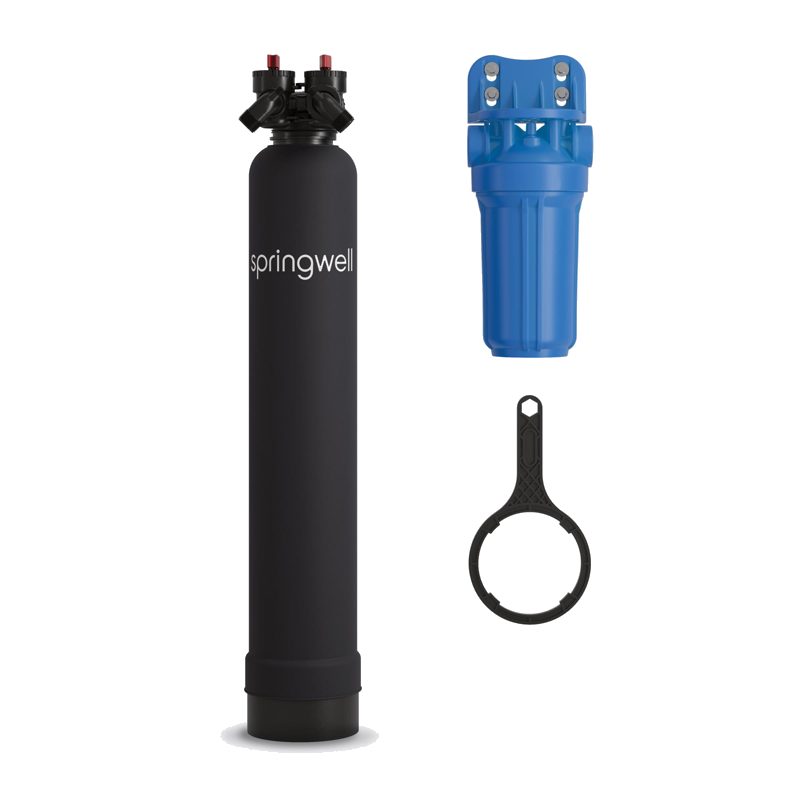
SpringWell FutureSoft salt-free conditioner
A salt-free scale-control system with a high hardness limit (81 gpg) that needs water with no iron or manganese at all.
Best for City water with no iron, where you want scale control without salt or a drain line
Photo: SpringWell Water
The FutureSoft has the highest published hardness limit of the systems here and flows 12 to 20 gpm depending on size. The catch is its strict 0 ppm iron and manganese requirement, plus a minimum pH of 7.0, so well owners almost always need treatment in front of it.
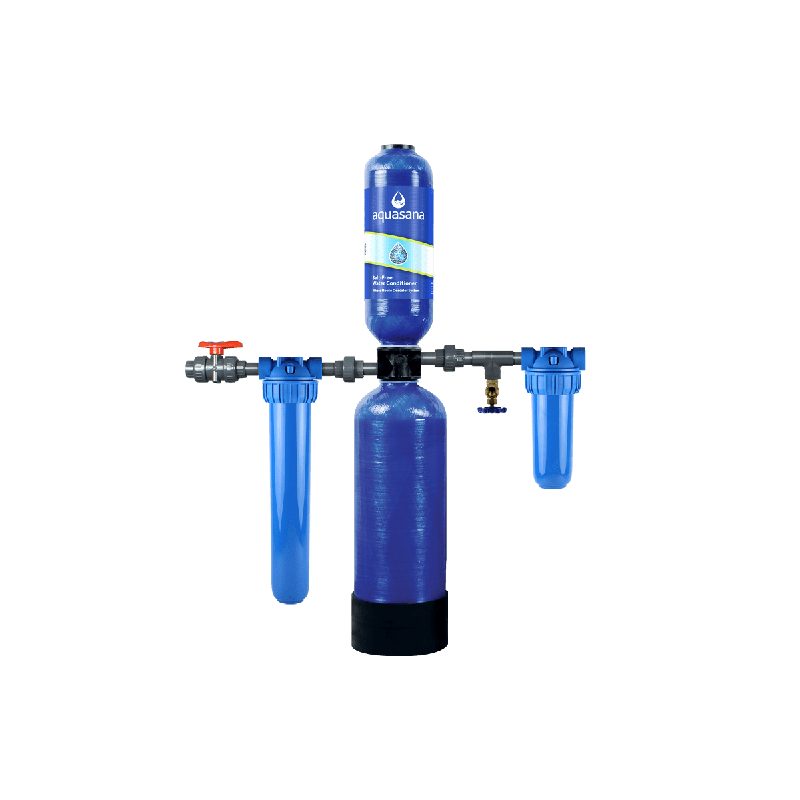
Aquasana SimplySoft salt-free conditioner
A salt-free conditioner for moderately hard water, with published limits for hardness, iron, alkalinity and pH and a rated life of 10 years or 1,000,000 gallons.
Best for City water under 15 gpg with no iron problem
Photo: Aquasana
Aquasana is the most modest in its claims: it says outright that the unit doesn’t reduce hardness, and it limits hardness to under 15 gpg. That makes it a fit for moderately hard city water and a poor one for anything harder.
Why salt-free softeners rarely suit well water
Iron, manganese and hydrogen sulfide show up in many wells, and every salt-free maker above wants them gone before the water reaches the media. SpringWell allows 0 ppm of either metal. Pentair’s NaturSoft manual says all iron, manganese, sulfur and tannins “should be removed prior.” US Water Systems likewise tells well owners using its GreenWave TAC system to pre-treat for iron, manganese, hydrogen sulfide and copper.
That means a salt-free system on most wells is really two systems: an iron and sulfur filter first, then the conditioner. At that point a salt softener often makes more sense: NDSU Extension notes that some softeners also remove up to 10 ppm of iron and manganese, though each model’s manual sets its own limit. Our iron filter vs water softener guide matches your iron, manganese and sulfur levels to the right equipment, and our guide to reading your well water test results explains which numbers to look for first. If you don’t have a recent lab test, get one before buying either type.
When a salt-free softener is worth it
A salt-free conditioner is a reasonable choice when all of these are true:
- You’re on city water, or a well with no iron, manganese or sulfur. Check your utility’s annual water quality report or a lab test against the table above.
- Your hardness is under the maker’s limit, ideally under about 29 gpg. That’s the top of what independent testing covered.
- Scale in the water heater and pipes is your main concern. That’s the one benefit with measured evidence behind it.
- You have a reason to avoid salt. No drain near the install spot, a household member told to limit sodium, a town that restricts softener discharge, or a septic system you’d rather not send brine to.
- You don’t need soft water. You’re fine with bar soap behaving much as it does now and with some spotting on glass and fixtures.
Maintenance is light: no salt, no electricity for TAC, and no regeneration water. The media still wears out, so check the rated life (10 years or 1,000,000 gallons for Aquasana, 5+ years for SpringWell media).
When to get a salt softener instead
Skip salt-free and buy an ion-exchange softener if any of these apply:
- You want soft water in the strict sense. The USGS classes water as soft at 0 to 60 mg/L of hardness (about 3.5 gpg). Only removing the calcium and magnesium gets you there, and only ion exchange (or reverse osmosis at one tap) does that at home.
- Your well has iron or manganese and you’d rather not run two systems. See our best water softeners for well water, which compares each softener’s published iron limit.
- Your hardness is very high. Above about 29 gpg, the only numbers you have are the makers’ own.
- Spots and soap scum bother you most. Those come from hardness still being in the water, and salt-free systems don’t take it out.
A salt softener costs more to run, mostly in salt: about 12 bags of 40 lb a year for a household of 4 on 15 gpg water at the efficient salt setting. Our softener running cost calculator works it out from your own hardness and household, and the softener size calculator tells you what capacity to shop for. If salt-free still fits your water, our picks of the best salt-free water softeners compare each system’s hardness, iron and pH limits, and our salt-free vs salt water softener comparison sets the two types side by side. The full range is in the salt-free conditioners section.
Questions people ask
Do salt-free water softeners remove calcium?
No. A template-assisted crystallization (TAC) unit changes how calcium behaves so less of it sticks as scale, but the calcium and magnesium stay in the water. Aquasana says plainly that its conditioner does not reduce hardness, and a water test after the unit will read about the same as before it.
Do salt-free water softeners remove iron?
No. SpringWell lists 0 ppm iron and manganese for the FutureSoft, Aquasana caps iron at 0.3 ppm, and Pentair's manual says all iron, manganese and sulfur should be removed before a NaturSoft. On a well with iron, the iron has to be filtered out first.
How long do salt-free water softeners last?
It depends on the media and the maker. Aquasana rates the SimplySoft at 10 years or 1,000,000 gallons, SpringWell lists 5+ years for FutureSoft media, and the TAC system in the Arizona State study came with a recommended media change every 12 to 18 months.
Will a salt-free system make my water feel soft?
No. The slippery feel of softened water comes from removing calcium and magnesium, and a salt-free conditioner leaves them in. Pentair's own NaturSoft manual says bar soap and oil-based soaps still form a sticky curd.