 Grain & Gallon
Sulfur smell in well water: causes and treatment by concentration
Sulfur smell in well water: check whether the water heater or the well is the source, then match treatment to your hydrogen sulfide level with Penn State.
A sulfur smell in well water comes from hydrogen sulfide, the gas behind the rotten egg smell. If only the hot tap smells, the water heater’s magnesium anode rod is a common cause, and replacing it with an aluminum rod is the first fix to try. If the cold water smells too, get a hydrogen sulfide test and choose treatment by the number: Penn State Extension lists activated carbon under about 1 mg/L, an oxidizing filter up to 2 to 3 mg/L, and continuous chlorination with filtration above 6 mg/L.
This guide covers the smell and the equipment that removes it. It does not cover health questions. For bacteria or any other health-related contaminant, test with a certified lab and choose equipment certified to the matching NSF/ANSI standard.
Hot water only or both: the first test
Where the smell shows up tells you where it starts. The Minnesota Department of Health’s page on hydrogen sulfide and sulfur bacteria gives a three-step check. Do it after the water has sat unused for a few hours, for example first thing in the morning.
- Smell the cold tap. If the cold water has no smell and the hot water does, the problem is in the water heater.
- If the cold water smells, try a tap that isn’t connected to the softener, such as an outdoor spigot that bypasses it. No smell there points to sulfur bacteria in the softener.
- Let the cold water run for a few minutes. If the smell fades, sulfur bacteria in the well or plumbing are the likely cause. If it stays just as strong, the likely cause is hydrogen sulfide gas in the groundwater itself.
| What you find | Likely source | Where to start |
|---|---|---|
| Hot tap only | Water heater | Replace the magnesium anode with an aluminum one |
| Cold smells, but not at a tap that bypasses the softener | Sulfur bacteria in the softener | Ask the installer or maker for disinfection steps |
| Cold smells, fades after a few minutes of running | Sulfur bacteria in the well or plumbing | Shock chlorination, then watch whether it returns |
| Cold smells and stays strong | Hydrogen sulfide in the groundwater | Test the level, then treat by concentration |
Only the last row calls for a whole-house filter sized to a number. The first three are cheaper ways to get rid of a sulfur smell in well water, so rule them out first.
When only the hot water smells: the anode rod
A tank water heater’s anode rod is there to protect the tank from corrosion. Penn State’s hydrogen sulfide guide explains that a magnesium rod “can chemically reduce sulfates to form hydrogen sulfide”, which is why the smell appears only on the hot side. Penn State says replacing it with an aluminum rod “should eliminate the rotten egg odor while maintaining corrosion protection.”
Don’t just pull the anode out and leave it out. Penn State warns that removal could increase corrosion and shorten the heater’s life, and the Minnesota Department of Health says the same. Get the replacement rod that your heater’s manual specifies.
If the cold water smells as well, a new anode won’t solve it. Go on to the causes below.
What causes sulfur smell in well water
Penn State traces most of it to sulfur-reducing bacteria. They “feed on small amounts of sulfur in the water and thrive in the low-oxygen environments present in groundwater wells and plumbing systems.” The Minnesota Department of Health adds two more sources: hydrogen sulfide that forms naturally from decay and chemical reactions with soil and rock, and bacteria or chemical reactions inside water heaters.
The source changes the fix. Gas that comes from the aquifer is there all the time and needs continuous treatment. Bacteria living in the well, the pipes or a treatment tank can sometimes be knocked back by disinfecting that one spot.
A sudden rotten egg smell
A smell that appears out of nowhere usually means something changed along the water’s path. Penn State notes that “in rare cases, adding water treatment equipment, like a water softener, may cause hydrogen sulfide production”, because the softener gives sulfur-reducing bacteria a place to grow. If the new smell is on the hot side only, check the water heater’s anode rod first, as described above.
Two clues point to bacteria rather than gas from the aquifer. The first is a smell that fades after the water runs for a few minutes (step 3 above). The second is slime, which the Minnesota Department of Health describes as white, grey or black, or reddish brown when iron bacteria are present too. If you see either, read the shock chlorination section before buying a filter.
Test for hydrogen sulfide before choosing treatment
Your nose tells you hydrogen sulfide is there but not how much. Penn State says most people can smell it “well below 0.5 mg/L”, so water at the low end of the carbon range already smells. A faint smell and a strong one can need very different equipment.
Hydrogen sulfide is a gas and escapes from a sample bottle. Penn State says the test “must be done in the home, or the sample must be chemically stabilized before being sent to a commercial testing lab.” A plain, unstabilized bottle will read low and can steer you to a filter that is too small. Ask the lab for its hydrogen sulfide sampling kit when you order.
Test iron, manganese, pH and hardness in the same round. The filters below publish iron and manganese limits, and most a pH range, next to their sulfur figure. Our guide to reading well water test results lists what to ask for and what each number means.
Sulfur smell in well water treatment by concentration
With a hydrogen sulfide number in mg/L (the same as ppm), Penn State’s guide gives these ranges:
| Hydrogen sulfide | Penn State’s suggested treatment | Notes from the same guide |
|---|---|---|
| Under about 1 mg/L | Activated carbon filter | Only for small concentrations |
| Higher than plain carbon can take | Catalytic carbon | Adsorbs the gas and then oxidizes it; no upper number given |
| Up to about 2 mg/L | Aeration | Normally not used above about 2 mg/L |
| Up to 2 to 3 mg/L | Oxidizing filter such as manganese greensand | |
| Above 6 mg/L | Continuous chlorination followed by filtration, or potassium permanganate | Penn State calls permanganate excellent above 6 mg/L |
Penn State gives no method for 3 to 6 mg/L. That gap is where the makers’ published limits matter, and they are covered in the filter section below. Penn State also calls hydrogen peroxide “an excellent oxidant for hydrogen sulfide” whose use in private home systems “has been limited”, and mentions ozone as another oxidizer.
To see which rule your whole test trips, including iron, manganese, pH and your pump’s flow, enter the numbers here. The hydrogen sulfide input stops at 15 mg/L.
Which treatment does my water need?
Enter the numbers from your water test. Each note that appears is a rule from Penn State Extension, NDSU, EPA or a manufacturer's published limit. It covers hardness, iron, manganese, sulfur smell and pH only.
Iron plus manganese
ppm
- Compensated hardness (5 gpg per ppm iron)
- gpg
- Hardness in mg/L
- mg/L
- Under 1 gpg counts as soft (Penn State, NDSU). You do not need a softener for hardness.
- Iron above 0.3 mg/L stains fixtures and laundry. That is EPA's secondary (aesthetic) standard, not a health limit.
- Manganese above 0.05 mg/L causes black or brown staining. That is EPA's secondary (aesthetic) standard.
- A softener can take this iron: dissolved iron under 5 mg/L with hardness of 3 to 20 gpg and pH above 6.7 (Penn State). Set the iron factor from your manual.
- If you don't want to soften, Penn State lists polyphosphate feed for iron under 2 mg/L (it keeps iron from staining but doesn't remove it) and catalytic carbon for iron under 1 mg/L.
- Iron plus manganese of 3 to 10 mg/L: Penn State lists an oxidizing filter (greensand, Katalox-type media or air injection). Put it before any softener.
- Over 10 mg/L combined: oxidation, such as chlorination, followed by filtration (Penn State). NDSU says over 10 ppm may need a dedicated iron removal system.
- Above 5 mg/L dissolved iron, Penn State does not recommend a softener for iron. Some manuals go higher (WaterBoss 900 and Whirlpool WHES40E 10 ppm, Whirlpool WHES44 12).
- Orange water or red particles mean the iron has already oxidized. It clogs softener resin, so filter it out before the softener (Penn State).
- Under about 1 mg/L hydrogen sulfide: activated carbon (Penn State).
- About 1 to 3 mg/L hydrogen sulfide: Penn State lists aeration up to about 2 mg/L and an oxidizing filter up to 2 to 3 mg/L.
- 3 to 6 mg/L falls between Penn State's ranges for oxidizing filters (up to 2 to 3 mg/L) and continuous chlorination (above 6). Ask the filter maker to confirm its sulfur limit for your level; SpringWell WS lists 8 ppm.
- Above 6 mg/L hydrogen sulfide: continuous chlorination followed by filtration (Penn State).
- A smell only in hot water often comes from the water heater's magnesium anode. Penn State suggests replacing it with an aluminum anode before buying treatment.
- Salt-free conditioners need iron, manganese and sulfur removed first. SpringWell FutureSoft lists 0 ppm iron and manganese, Aquasana SimplySoft under 0.3 ppm iron, and Pelican's manual says to remove all iron, manganese and sulfur.
- Aquasana SimplySoft is rated for hardness below 15 gpg. SpringWell FutureSoft lists up to 81 gpg and Pelican NaturSoft up to 75 gpg.
- Aquasana SimplySoft is rated for pH below 8.3.
- Below pH 7: under the minimum for the WaterBoss 900, SpringWell FutureSoft and Pelican NaturSoft. SpringWell's SS softener and WS iron filter list 6.5 to 10. Check the pH range of any product you consider.
- Under 5 gpm is below the backwash minimum of even the smallest iron filter with a published minimum (SoftPro Iron Master 1.0 ft³ needs 5 gpm). Ask the maker for a filter sized to your pump.
- Backwashing filters need a minimum pump flow. SoftPro Iron Master needs 5, 7 and 10 gpm for its 1.0, 1.5 and 2.0 ft³ sizes, so choose a size your pump can backwash.
- The Whirlpool WHES40E manual asks for at least 3 gpm of supply flow.
- This covers nuisance parameters only. For health-related contaminants, test with a certified lab and choose equipment certified to the matching NSF/ANSI standard.
How this works: Each note is one rule from a published source: Penn State Extension (water softening; iron and manganese; hydrogen sulfide), NDSU WQ1031, EPA secondary standards (aesthetic, not health) and manufacturer limits for SpringWell, Aquasana, Pelican, WaterBoss, Whirlpool and SoftPro. Sources disagree on iron: dealers often set 2 ppm, Penn State says under 5 mg/L for softening, and softener manuals rate 10 to 12 ppm. Compensated hardness uses 5 gpg per ppm iron, the factor in the Whirlpool and WaterBoss manuals. mg/L of hardness is gpg times 17.1.
Shock chlorination for a bacteria-caused smell
Shock chlorination means pouring a chlorine solution into the well to kill bacteria. Penn State calls it a common first step for bacterial problems in wells. For sulfur bacteria it is honest about the result: “sulfur-reducing bacteria and hydrogen sulfide odor will return quickly after shock chlorination” in most cases. The Minnesota Department of Health says chlorination can kill sulfur bacteria, and that if not all of them die, the problem may return within a few weeks.
So treat shock chlorination as a test as much as a fix. If the smell stays gone, the bacteria were in the well or plumbing and you may not need equipment. If it comes back within weeks, plan on continuous treatment from the table above, or a filter rated for bacteria. For bacteria in the softener, the Minnesota Department of Health says to ask the installer or manufacturer for disinfection instructions.
We don’t give chlorine doses here. Follow your state’s or extension service’s written procedure, or hire a licensed well contractor. Whether the well has bacteria of health concern is a separate question for a certified lab.
Hydrogen sulfide removal filters by published limit
Most whole-house iron filters also remove hydrogen sulfide, which is why sellers name them iron and sulfur filters. Our guide to how iron filters work explains how air, peroxide and the media do the oxidizing. What they don’t share is a limit. These are the figures each maker or seller publishes:
| Filter | How it oxidizes | Published sulfur limit | The catch |
|---|---|---|---|
| US Water Systems Matrixx InFusion | Hydrogen peroxide injection, catalytic carbon | 30 ppm hydrogen sulfide | Peroxide refills and a 15 gallon solution tank |
| Mid Atlantic Water Fleck 2510AIO, Katalox Light | Air injection, Katalox Light | 10 ppm “sulfur” (seller claim) | Needs at least 8 gpm of well flow to backwash |
| SpringWell WS | Air injection, greensand fusion media | 8 ppm hydrogen sulfide | Manganese limit of 1 ppm; backwashes nightly |
| US Water Systems Flexx Oxi-Gen | Air injection, Katalox and catalytic carbon | 6 ppm “sulfur” | Not recommended for iron or sulfur reducing bacteria |
| SoftPro Iron Master | Air injection, Katalox Light | Claimed, no number published | Needs 5 to 10 gpm to backwash, by size |
Two sellers list “sulfur” rather than hydrogen sulfide. We quote them as written and read them as the rotten egg smell they sell against, but ask before you rely on the number.
Every maker figure here is above Penn State’s 2 to 3 mg/L for oxidizing filters. Penn State describes generic greensand filters; the makers rate their own systems, which add air injection, catalytic carbon or peroxide. Treat a published limit as a ceiling for water that also stays inside the filter’s iron, manganese and pH ranges, not as a target. If your level sits near it, send the seller your test. SpringWell already requires one before it ships a well system. Our roundup of the best iron filters for well water sets these limits beside each filter’s iron, manganese and backwash figures.
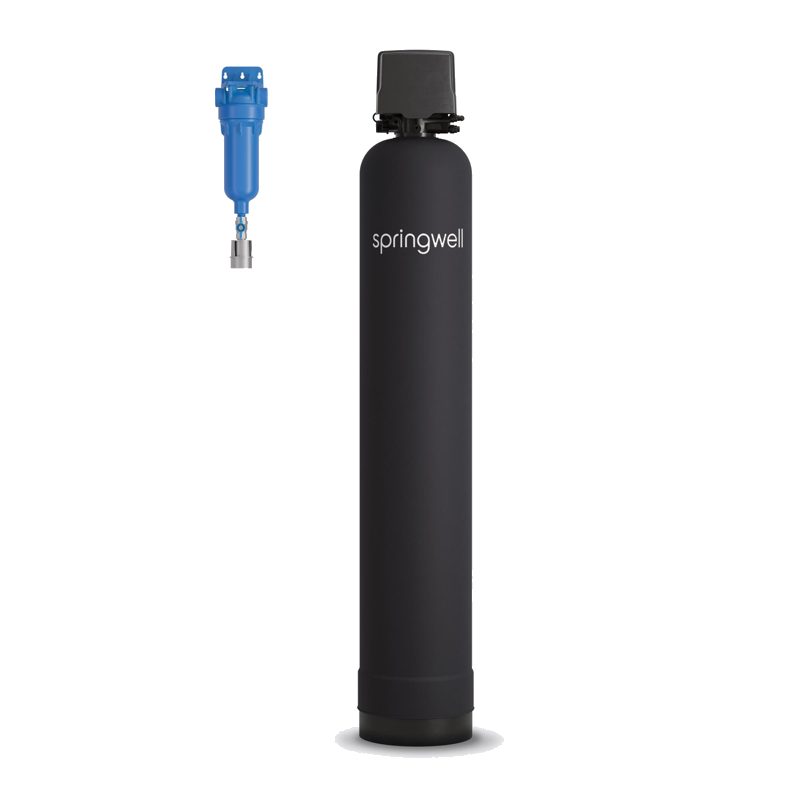
SpringWell WS well water filter
A single-tank air-injection iron filter with published limits for iron, manganese and hydrogen sulfide, and a nightly backwash.
Best for Wells with moderate iron plus a sulfur smell
Photo: SpringWell Water
The SpringWell WS fits a well where the smell comes with moderate iron: its page lists 8 ppm hydrogen sulfide and 7 ppm iron, with a pH range of 6.5 to 10. It uses air, so there’s nothing to refill. The weak points are manganese, limited to 1 ppm, and the nightly backwash, which needs a drain and enough pump flow. Its installation manual lists a backwash rate of 5 gpm for the WS1 and 7 gpm for the WS4, so check your pump against that before you order. It is not the pick for a strong smell caused by bacteria.
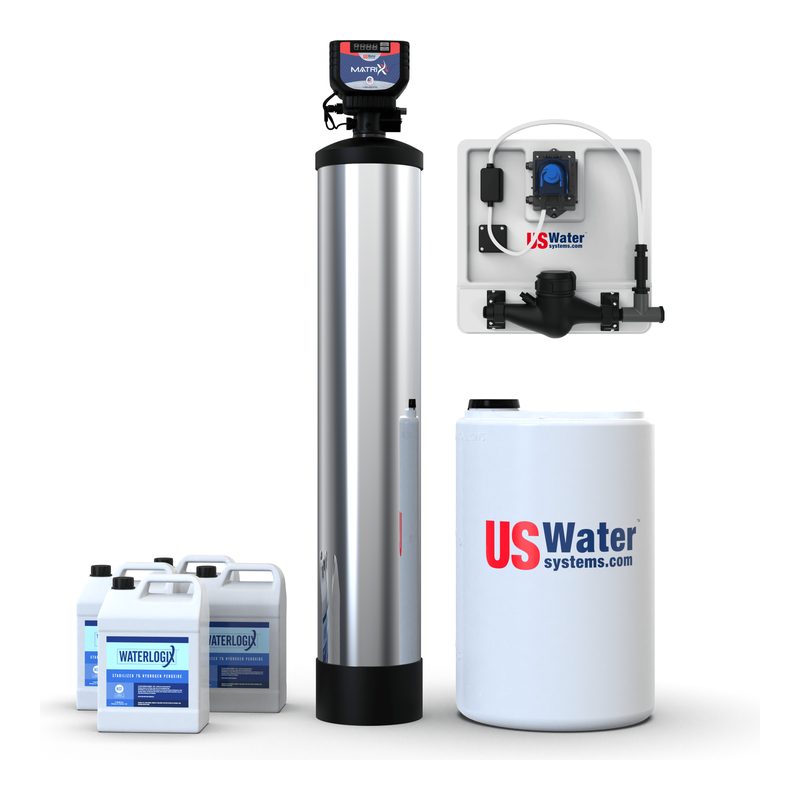
US Water Systems Matrixx InFusion
A hydrogen peroxide injection system with a catalytic carbon tank, rated for the strongest sulfur of any filter we list and, per the seller, for iron and sulfur bacteria too.
Best for Strong rotten-egg smell, high hydrogen sulfide or iron bacteria
Photo: US Water Systems
The Matrixx InFusion is the one to look at when the smell is strong. It lists 30 ppm hydrogen sulfide, far above any other filter here, and the seller says it also works with iron and sulfur reducing bacteria. The cost is upkeep: you buy hydrogen peroxide (a 7% solution, per the seller’s FAQ), make room for a 15 gallon solution tank and an injection pump, and it backwashes about every two days per the product page (every 3 days by default in the owner’s manual). Its manganese limit is 1 ppm. For a mild smell under about 1 mg/L, it’s more system than you need.
Softeners and salt-free units don’t remove sulfur
A water softener is not a hydrogen sulfide treatment. It swaps calcium and magnesium for sodium, and Penn State’s guide lists it only as a rare cause of the smell, never as a cure. If your water is hard and smells, you need an iron and sulfur filter first and the softener after it. Our iron filter vs water softener guide explains that install order and what each device takes out.
Salt-free conditioners are stricter still. SpringWell’s FutureSoft spec table lists 0 for hydrogen sulfide. Pelican’s NaturSoft manual says all iron, manganese and sulfur “should be removed prior”, and US Water Systems tells well owners to pre-treat hydrogen sulfide before its GreenWave. Our guide on whether salt-free water softeners work covers their other limits.
If you still need a softener once the smell is handled, the best water softeners for well water are ranked on their published iron limits. For SpringWell’s WS set up alongside a softener, see SpringWell vs SoftPro. More guides on iron, sulfur and well tests are in the well water section.
Questions people ask
Why does my well water smell like sulfur only in hot water?
A smell from the hot tap only usually starts in the water heater. Penn State Extension explains that the heater's magnesium anode rod can chemically turn sulfate in the water into hydrogen sulfide, and that replacing it with an aluminum rod should remove the odor while still protecting the tank.
Will a water softener remove sulfur smell?
No. A softener exchanges hardness minerals for sodium and is not a hydrogen sulfide treatment. Penn State notes that in rare cases a softener can even give sulfur-reducing bacteria a place to grow, so the smell gets worse after one is installed.
Why did my well water suddenly start smelling like rotten eggs?
A sudden change usually means something new in the path of the water, such as new treatment equipment where sulfur bacteria can grow, which Penn State notes can happen in rare cases with a softener. The hot and cold tap test from the Minnesota Department of Health narrows it down to the heater, the softener, the plumbing or the well.
Do iron filters remove sulfur?
Many do, up to a limit their maker publishes. SpringWell lists 8 ppm hydrogen sulfide for its WS filter and US Water Systems 30 ppm for the Matrixx InFusion, while SoftPro claims sulfur removal for the Iron Master without giving a number.